


Observation of Dirac fermions in atomically thin silicon sheet
Date:20-08-2012 Print
Group IV (Si, Ge) analogs of graphite have been discussed for a long time even before the synthesis of isolated graphene, and recently there has been renewed interest in this topic due to the novel concepts and applications brought on by graphene. As the theoretical studies on silicene are rapidly increasing, the major challenge in this field is now the preparation of high quality silicene films. However, to date, there is still no solid evidence for the observation of a silicene film.
Recently, Kehui Wu, Lan Chen and their colleagues in the State key lab for surface physics, Institute of Physics, Chinese Academy of Sciences have made significant progress in the preparation of silicene and investigation on their electronic properties. They performed systematic study of the self organized superstructures formed by submonolayer silicon grown on Ag(111), by STM and scanning tunneling spectroscopy (STS). They found that, depending on the substrate temperature and silicon coverage, several monolayer superstructures can form on Ag(111). These superstructures are distinct from any known surface structures of bulk silicon and are characterized by honeycomb building blocks and structures. At sufficiently high temperature and Si coverage, monolayer and multilayer silicene films were grown. This work provides a complete understanding of the structure evolution of Si on Ag(111), which is desirable for fabrication of high-quality silicene and exploring its novel physics and applications. This work has been published in Nano Letters 12, 3507 (2012).
To further investigate the electronic property of silicene, they perform STM/STS using a fully home-made low temperature (4K) scanning tunneling microscopy/spectroscopy. They found that the electronic property measured by STS is consistent with theory very well. For example, quasiparticle interference (QPI) patterns suggesting intervalley and intravalley scattering of charge carriers were observed, and a linear energy-momentum dispersion relation and a large Fermi velocity were derived. These results unambiguously prove the existence of Dirac fermions in silicene, and provide a solid basis for further studies on the electronic property and device applications of silicene. This work has been published in Physical Review Letters 109, 056804 (2012).
The above works have been financially supported by CAS and NSF.
Recently, Kehui Wu, Lan Chen and their colleagues in the State key lab for surface physics, Institute of Physics, Chinese Academy of Sciences have made significant progress in the preparation of silicene and investigation on their electronic properties. They performed systematic study of the self organized superstructures formed by submonolayer silicon grown on Ag(111), by STM and scanning tunneling spectroscopy (STS). They found that, depending on the substrate temperature and silicon coverage, several monolayer superstructures can form on Ag(111). These superstructures are distinct from any known surface structures of bulk silicon and are characterized by honeycomb building blocks and structures. At sufficiently high temperature and Si coverage, monolayer and multilayer silicene films were grown. This work provides a complete understanding of the structure evolution of Si on Ag(111), which is desirable for fabrication of high-quality silicene and exploring its novel physics and applications. This work has been published in Nano Letters 12, 3507 (2012).
To further investigate the electronic property of silicene, they perform STM/STS using a fully home-made low temperature (4K) scanning tunneling microscopy/spectroscopy. They found that the electronic property measured by STS is consistent with theory very well. For example, quasiparticle interference (QPI) patterns suggesting intervalley and intravalley scattering of charge carriers were observed, and a linear energy-momentum dispersion relation and a large Fermi velocity were derived. These results unambiguously prove the existence of Dirac fermions in silicene, and provide a solid basis for further studies on the electronic property and device applications of silicene. This work has been published in Physical Review Letters 109, 056804 (2012).
The above works have been financially supported by CAS and NSF.
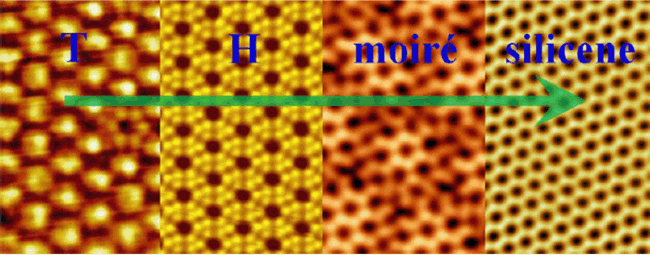 |
| Figure 1 : Evolution of difference ordered phases formed by Si on Ag(111) (Image by Kehui Wu et al.) |
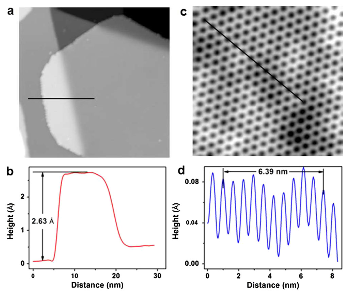 |
| Figure 2 : The monolayer silicene sheet on Ag(111) and high resolution STM images(Image by Kehui Wu et al.) |
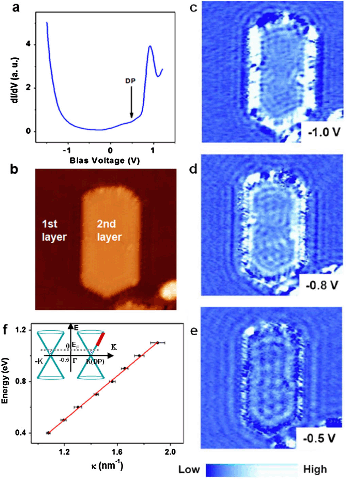 |
| Figure 3 : STS maps obtained on a silicene island show strong quasiparticle interference patterns with the wavelength dependent on energy. The derived linear dispersion shows the existence of Dirac fermions. (Image by Kehui Wu et al.) |