


Scientists Discover Electronic Origin of High Temperature Superconductivity in Single-Layer FeSe Superconductor
Date:23-08-2012 Print
Searching for novel superconductors with higher superconducting transition temperature (Tc) and understanding the mechanism of high temperature superconductivity are two prominent issues facing the current research of superconductivity.
Using self-developed high resolution angle-resolved photoemission spectroscopy (ARPES) system, ZHOU Xingjiang’s group in the Institute of Physics (IOP), Chinese Academy of Sciences, in collaboration with Prof. XUE Qikun’s group in the Department of Physics, Tsinghua University and MA Xucun’s group at IOP, reported the electronic structure and superconducting gap in the single-layer FeSe superconductor.
The Fermi surface is distinct from other iron-based superconductors, consisting only of electron-like pockets near the zone corner without indication of any Fermi surface around the zone center. Nearly isotropic superconducting gap is observed in this strictly two-dimensional system. The temperature dependence of the superconducting gap gives a transition temperature Tc at ~55 K. These results have established a clear case that such a simple electronic structure is compatible with high-Tc superconductivity in the Fe-based superconductors. It will provide key insights on understanding superconductivity mechanism in the Fe-based superconductors.
The related work is published in Liu Defa et al., Nature Communications 3 (2012) 931. This work is supported by grants from the Ministry of Sciences and Technology of China, and the National Natural Science Foundation of China. (http://www.nature.com/ncomms/journal/v3/n7/full/ncomms1946.html)
Using self-developed high resolution angle-resolved photoemission spectroscopy (ARPES) system, ZHOU Xingjiang’s group in the Institute of Physics (IOP), Chinese Academy of Sciences, in collaboration with Prof. XUE Qikun’s group in the Department of Physics, Tsinghua University and MA Xucun’s group at IOP, reported the electronic structure and superconducting gap in the single-layer FeSe superconductor.
The Fermi surface is distinct from other iron-based superconductors, consisting only of electron-like pockets near the zone corner without indication of any Fermi surface around the zone center. Nearly isotropic superconducting gap is observed in this strictly two-dimensional system. The temperature dependence of the superconducting gap gives a transition temperature Tc at ~55 K. These results have established a clear case that such a simple electronic structure is compatible with high-Tc superconductivity in the Fe-based superconductors. It will provide key insights on understanding superconductivity mechanism in the Fe-based superconductors.
The related work is published in Liu Defa et al., Nature Communications 3 (2012) 931. This work is supported by grants from the Ministry of Sciences and Technology of China, and the National Natural Science Foundation of China. (http://www.nature.com/ncomms/journal/v3/n7/full/ncomms1946.html)
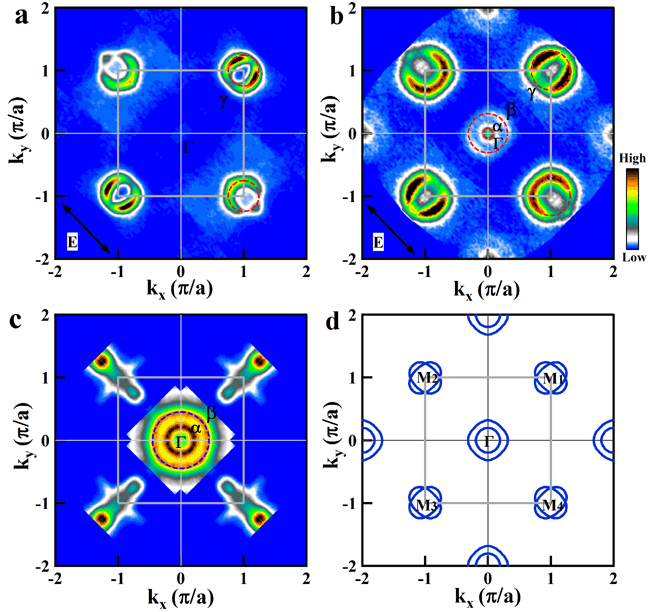 |
| Figure 1. (a). Fermi surface of the single-layer FeSe superconductor. In comparison, the measured Fermi surface of (Tl,Rb)xFe2-ySe2superconductor (Tc=32 K) (b), measured Fermi surface of (Ba1.6K0.4)Fe2As2superconductor (Tc=35K) (c), and calculated Fermi surface of β-FeSe (d), are also included. (Image by ZHOU Xingjiang et al.) |
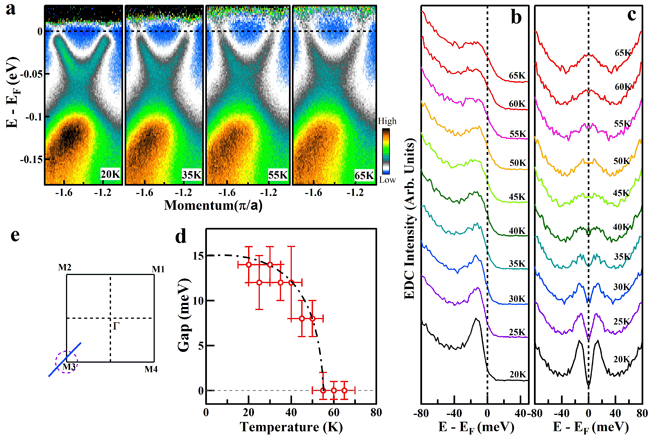 |
| Figure 2. Temperature dependence of the superconducting gap of the single-layer FeSe superconductor. ( a ). Typical photoemission images along the momentum cut near the M3 point (blue line in ( e )) measured at different temperatures. (b). Photoemission spectra at the Fermi crossings and their corresponding symmetrized spectra (c) measured at different temperatures. (d). Temperature dependence of the superconducting gap. The dashed line is a BCS gap form that gives a gap size of 15 meV at zero temperature and a Tcat ~55 K. (Image by ZHOU Xingjiang et al.) |