


Relation between interface structure and optoelectronic property revealed for molecular solar cells
Date:25-10-2012 Print
Molecular solar cells are one of most promising alternates to traditional high cost single-crystal solar cells. Such cells employ organic molecules and benefit from their high extinction coefficient, nontoxicity, easy fabrication and low cost. To date this type of cells has reached a high efficiency >13% (under 50% sun illuminating) and long term stability.
Although many experiments have been conducted on measuring macroscopic properties, the lack of microscopic insights into the relationship between interface structure and energy conversion characteristics hinders further improvements in solar cell performance. Now a research group led by Professor MENG Sheng at Institute of Physics, Chinese Academy of Sciences has made a key step forward.
Meng and graduate students JIAO Yang, ZHANG Fan, DING Zijing have carried out first-principles simulation of excited state dynamics and spectroscopic studies to reveal that molecular energy levels on TiO2 are tuned by vibrations, an important insight for understanding ultrafast electron injection. In addition, different alignment of CuPc molecules at interface has a significant impact on electronic level alignment, in turn open-circuit voltage of solar cell. Consequently a 0.3 V higher voltage can be achieved if horizontal aligned C60/CuPc interface is achieved. The work is published on Nano Research 5, 248 (2012).
Solar cells based on cyanoacrylic organic dyes reach high efficiency (>10%) and are most promising. It is commonly assumed that a cyanoacrylic dye anchors on TiO2 surface with only carboxyl group, similar to cases of conventional Ru-complex dyes. However, the study performed by Meng et al. challenges previous common senses and provides solid evidences that cyano group plays a crucial role in maintaining interface stability and beneficial electrochemical properties (Figure 1).
They performed detailed analysis of interface dynamics, vibrational spectra, and photoexcited electron injection. The newly identified, most stable interface configuration provides benign electronic structure, higher open voltage and larger quantum yield (Figure 2). This work establishes a causal link between atomic-scale interface structure and macroscopic property of solar cell devices, and provides a solution to improve further solar cell efficiencies. The work is published on Advanced Functional Materials, DOI: 10.1002/adfm.201201831 (2012), and supported by NSFC and CAS.
Article links:
1. “Theoretical Investigation of the C60/Copper-Phthalocyanine Organic Photovoltaic Heterojunciton”
http://www.springerlink.com/content/8114323v54104648/
2.Structure–Property Relations in All-Organic Dye-Sensitized Solar Cells”
http://onlinelibrary.wiley.com/doi/10.1002/adfm.201201831/pdf
Although many experiments have been conducted on measuring macroscopic properties, the lack of microscopic insights into the relationship between interface structure and energy conversion characteristics hinders further improvements in solar cell performance. Now a research group led by Professor MENG Sheng at Institute of Physics, Chinese Academy of Sciences has made a key step forward.
Meng and graduate students JIAO Yang, ZHANG Fan, DING Zijing have carried out first-principles simulation of excited state dynamics and spectroscopic studies to reveal that molecular energy levels on TiO2 are tuned by vibrations, an important insight for understanding ultrafast electron injection. In addition, different alignment of CuPc molecules at interface has a significant impact on electronic level alignment, in turn open-circuit voltage of solar cell. Consequently a 0.3 V higher voltage can be achieved if horizontal aligned C60/CuPc interface is achieved. The work is published on Nano Research 5, 248 (2012).
Solar cells based on cyanoacrylic organic dyes reach high efficiency (>10%) and are most promising. It is commonly assumed that a cyanoacrylic dye anchors on TiO2 surface with only carboxyl group, similar to cases of conventional Ru-complex dyes. However, the study performed by Meng et al. challenges previous common senses and provides solid evidences that cyano group plays a crucial role in maintaining interface stability and beneficial electrochemical properties (Figure 1).
They performed detailed analysis of interface dynamics, vibrational spectra, and photoexcited electron injection. The newly identified, most stable interface configuration provides benign electronic structure, higher open voltage and larger quantum yield (Figure 2). This work establishes a causal link between atomic-scale interface structure and macroscopic property of solar cell devices, and provides a solution to improve further solar cell efficiencies. The work is published on Advanced Functional Materials, DOI: 10.1002/adfm.201201831 (2012), and supported by NSFC and CAS.
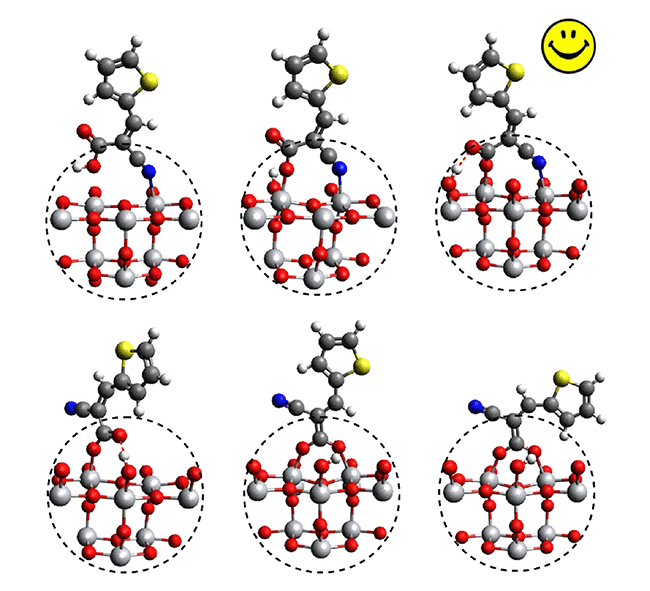 |
| Figure 1. Adsorption structures of cyanoacrylic organic molecules on TiO2. The upper row (from left to right: Ia, Ib, Ic): structures with Ti-N bond; the lower row (IIa, IIb, IIc): structures without Ti-N bond. Upper-right configuration Ic is the newly identified, most stable structure. (Image by MENG Sheng et al) |
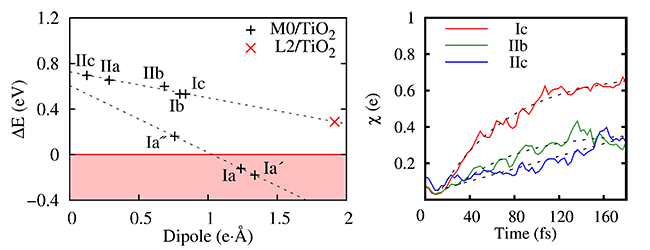 |
| Figure 2: Left: Relationship between different interface structures and open-circuit voltage VOC. Right: Electron dynamics for different adsorption structures. (Image by MENG Sheng et al) |
Article links:
1. “Theoretical Investigation of the C60/Copper-Phthalocyanine Organic Photovoltaic Heterojunciton”
http://www.springerlink.com/content/8114323v54104648/
2.Structure–Property Relations in All-Organic Dye-Sensitized Solar Cells”
http://onlinelibrary.wiley.com/doi/10.1002/adfm.201201831/pdf