


Microscopic coexistence of antiferromagnetic order and superconductivity in iron pnictide revealed by NMR
Date:07-12-2012 Print
Recently, ZHENG Guoqing’s group in the Institute of Physics, Chinese Academy of Sciences has carried out in-depth studies on Ba1-xKxFe2As2 superconductors by nuclear magnetic resonance (NMR). Their results show unambiguously that superconductivity coexists with an antiferromagnetic order at a microscopic length scale. Namely, the same d-electrons of Fe are responsible for both superconductivity and magnetism. They also revealed novel superconducting properties in the coexisting region, which call for further investigations.
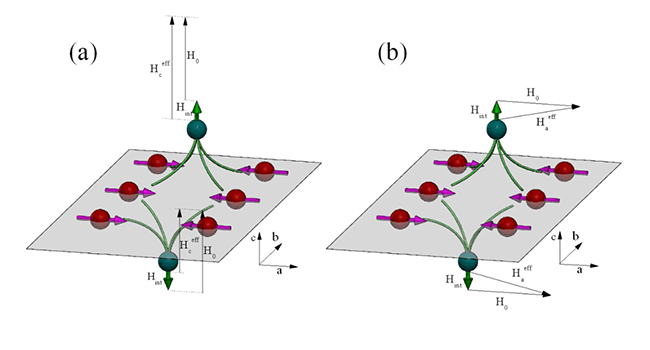
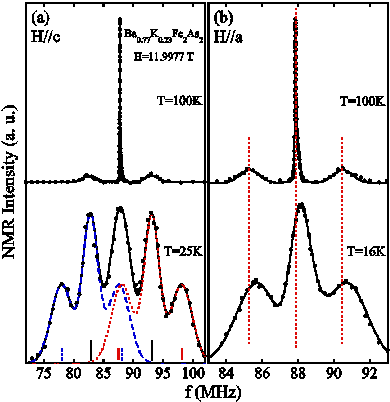
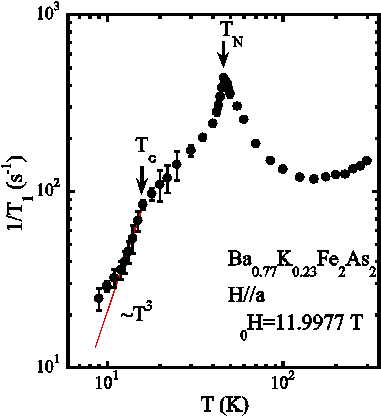
In this work, the group performed 75As NMR measurements on an underdoped single-crystal Ba0.77K0.23Fe2As2. Below TN = 46 K, the NMR transition peaks for H//c split and those for H//a shift to higher frequencies, which indicates that the antiferromagnetic order sets in. The spin-lattice relaxation rate 1/T1 measured at the nuclei which experience an internal magnetic field shows distinct reduction below Tc = 16 K. This is clear and direct evidence for the microscopic coexistence of antiferromagnetic order and superconductivity. Moreover, the temperature dependence of 1/T1 below Tc is found to be much weaker than that in the optimally doped sample Ba0.68K0.32Fe2As2 previously reported by the same group (Z. Li et.al. Phys. Rev. B 83, 140506(R) (2011)), where 1/T1 follows an exponential decrease. This indicates that the superconducting state coexisting with magnetism is unusual and deserves further studies, in particular, theoretically.
The results have been published in Physical Review B as a Highlighted Article (Ediotrs’ suggestion) (Phy. Rev. B 86, 180501 (R) (2012)). This work was supported by National Basic Research Program of China (973 Program) and National Natural Science Foundation of China Grants.
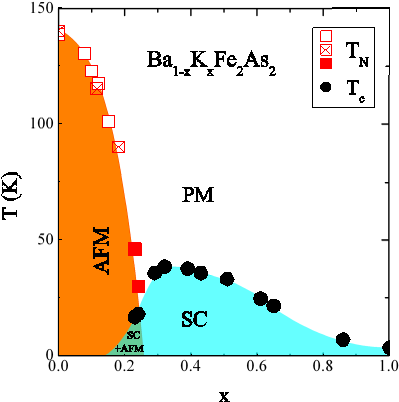 |
| Figure-1:Phase diagram of Ba1-xKxFe2As2obtained from NMR measurements. The solid squares designate the Néel temperature TN,The solid circles indicate the superconducting transition temperatureTc. AFM, PM, and SC represent antiferromagnetically ordered, paramagnetic, and superconducting states, respectively.(Image by ZHENG Guoqing et al) |
 |
|
Figure-2:The effective magnetic field Heffat the As-site (green arrow), when the external field H0 is applied along the c-axis (left) and along the a-axis (right), respectively. The red arrow designates the Fe moments which lie on theabplane. (Image by ZHENG Guoqing et al) |
 |
|
Figure-3:75As NMR spectra above and below TNfor (a) H//c and (b) H//a, respectively. (a) The spectra split into two sets below TN, for H//c. (b) The spectra shift to higher frequency below TN, for H//a. (Image by ZHENG Guoqing et al) |
 |
|
Figure-4:The temperature dependence of the spin-lattice relaxation rate 1/T1. The peak at TNis due to antiferromagntic transition and the drop atTcindicates superconducting transition. (Image by ZHENG Guoqing et al) |