


High-Strength Laminated Metal Composites Based on Single-Walled Carbon Nanotube Film with Continuous Reticulate Architecture
Date:28-02-2013 Print
Single-walled carbon nanotubes (SWCNTs) possess excellent physical and chemical properties due to their unique structures. SWCNTs have great potentials for improving the mechanical, thermal, electrochemical and electrical properties of composite materials, which have inspired researchers to use SWCNTs as reinforcements in metal and ceramic matrices as well as polymer matrices.
Recently, the group of Nanomaterials and Mesoscopic Physics (Group A05) at the Laboratory for Advanced Materials & Structure Analysis, Institute of Physics, Chinese Academy of Sciences, reported creative results on composite based on SWCNT films with continuous reticulate architecture. Dr. NIU Zhiqiang, Prof. ZHOU Weiya, Prof. XIE Sishen, and co-workers developed a strategy of fabricating high strength Cu/SWCNT/Cu sandwich-type laminated nanocomposites.
A critical challenge in nanocomposite fabrication by adding SWCNTs as reinforcement is to realize an effective transfer of the excellent mechanical properties of SWCNTs to the macroscale mechanical properties of the matrix. Progress has been made in SWCNT/polymer composites, which exhibit a remarkable strengthening effect for the polymers due to the strong interfacial strength between the SWCNTs and the polymer matrix induced by their interaction at the molecular level. However, it is difficult to fabricate SWCNT/metal composites with effective load transfer due to the agglomeration of the SWCNTs in the matrix and the poor interfacial bonding because of the mere blending between SWCNTs and the metal matrix in the traditional powder-metallurgy processes.
Niu et al. reported a simple method to fabricate Cu/SWCNT/Cu sandwich-type laminated nanocomposites effectively by electrodeposition using freestanding SWCNT films with continuous reticulate structure as template. By this method, the SWCNT films in Cu/SWCNT/Cu laminated nanocomposites can not only keep continuous reticulate structure within the plane easily, but also realize orientation control of SWCNTs. Continuous reticulate architecture of the SWCNT films and the strong interfacial strength between the SWCNTs and Cu matrix result in the effective load-transfer of the SWCNT bundles in the laminated nanocomposites. The estimated Young’s modulus of the SWCNT bundles in the composite is in a range of 860-960 GPa. Such a high load-transfer efficiency leads to the extremely high mechanical properties of the laminated composites. The loading status of the SWCNTs in metal-matrix composite during straining was successfully characterized through Raman spectroscopy, which provides a way to investigate the load transfer of SWCNTs in the metal matrix composite. The research results have been published in Advanced Functional Materials (2012, 22, 5209).
This work is financially supported by the National Natural Science Foundation of China, the Ministry of Science and Technology of China, and Beijing Municipal Education Commission.
Link to the relative article:
1) High-Strength Laminated Copper Matrix Nanocomposites Developed by Single-Walled Carbon Nanotube Film with Continuous Reticulate Architecture.pdf
2) http://onlinelibrary.wiley.com/doi/10.1002/adfm.v22.24/issuetoc
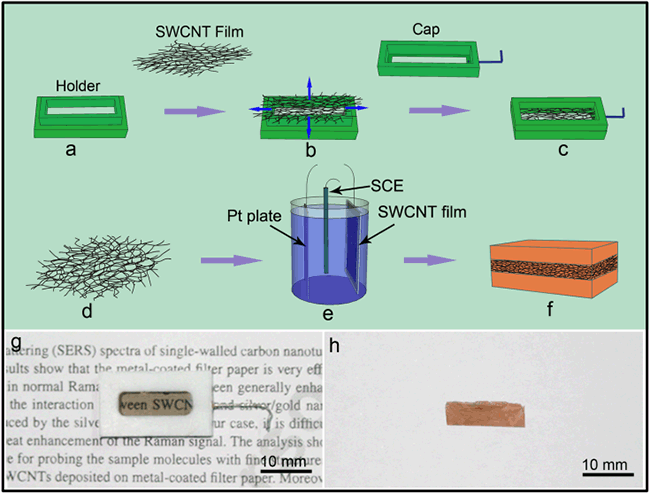 |
| Figure 1 Schematically process of spreading out SWCNT film flatly (a-c) and electrodepositing Cu using SWCNT film as template (d-f). Optical images of the SWCNT film fixed between “Holder” and “Cap” (g) and the Cu/SWCNT/Cu laminated nanocomposite (h).(Image by XIE Sishen et al) |
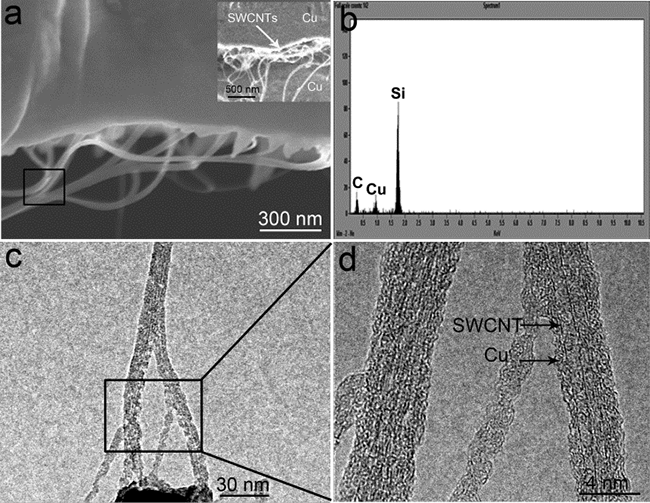 |
| Figure 2 SEM image (a) and EDX spectrum (b) of the fracture edge of the laminated nanocomposites. TEM images of the SWCNT pullout at the fracture edge at low (c) and high (d) magnifications. (Image by XIE Sishen et al) |
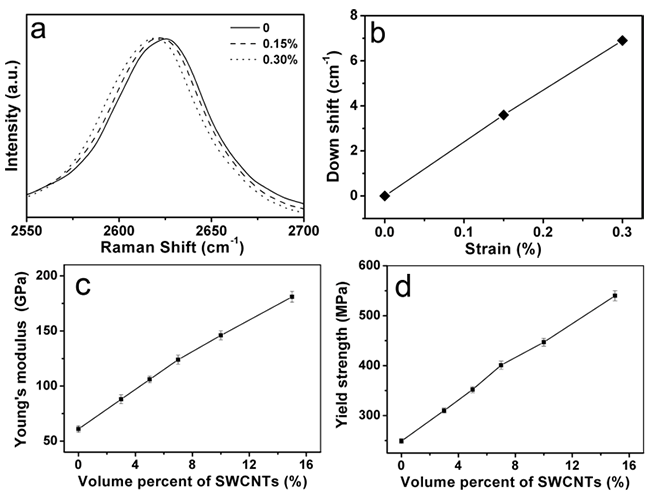 |
| Figure 3 G′ bands of SWCNTs in Cu/SWCNT/Cu laminated nanocomposites under different strains (a). Downshift of G′ bands under different strains (b). Young’s modulus (c) and yield strength (d) of the Cu/SWCNTs/Cu laminated nanocomposites with different volume percentage of the SWCNTs. (Image by XIE Sishen et al) |