


Clarifying Superconducting Phases in Potassium-Intercalated Iron Selenides
Date:11-03-2013 Print
Considerable progress has been made in the study of AxFe2-ySe2 (A = K, Cs, Rb, Tl/Rb, Tl/K) since the discovery of superconductivity at ~30 K in K0.8Fe2Se2 [Phys. Rev. B 2010, 82, 180520(R)]. The insulating 245 phases and superconducting (SC) phases have been proved to coexist in AxFe2-ySe2 formed by high-temperature routes by various techniques. The dominant 245 phases, however, are insulating and not responsible for the observed superconductivity. SC phases are generally thought to precipitate from AxFe2-ySe2 into nanoscale strips that intergrow with the 245 phases. Their volume fractions are estimated to be 10-20%. Previous efforts to obtain pure or SC-dominated phases by using Bridgeman or other high-temperature routes have failed. A 44 K SC phase with trace fraction was also observed apart from the 30 K phase in some samples, further complicating the identification of SC phases. Thus, one has good reasons to think the previously reported properties of this family of superconductors are flawed or even dubious, considering that the ‘single crystal’ samples on which measurements were done actually consist of majority 245 phases and minority SC phases. It is a pressing and important issue to obtain pure SC phases or real single crystals to clarify their peculiar electronic structures and study the intrinsic properties of this new family of superconductors.
In 2012, Prof. CHEN Xiaolong and coworkers from Beijing National Laboratory for Condensed Matter Physics, the Institute of Physics, Chinese Academy of Sciences reported the syntheses of a serious superconductors with Tc = 30~46 K by intercalating metals Li, Na, Ba, Sr, Ca, Yb, and Eu between FeSe layers via a liquid ammonia route [Sci. Rep. 2012, 2, 426], which allows them to tune the concentrations of intercalated metals at room temperature, implying an alternative for preventing phase separation. Now they report that, in the K-intercalated iron selenides, there are at least two SC phases, KxFe2Se2(NH3)y (x ≈ 0.3 and 0.6) determined mainly by potassium concentration. K0.3Fe2Se2(NH3)0.47 corresponds to the 44 K phase with lattice constant c = 15.56(1) Å and K0.6Fe2Se2(NH3)0.37 to the 30 K one with c = 14.84(1) Å. With higher potassium doping, the 44 K phase can be converted into the 30 K phase. The NH3 extraction while keeping the lattice from collapsing demonstrates that NH3 only causes the constant c to decrease and has little, if any, effect on superconductivity. Thus, the conclusion should apply to both K0.3Fe2Se2 and K0.6Fe2Se2 SC phases. K0.3Fe2Se2(NH3)0.47 and K0.6Fe2Se2(NH3)0.37 stand out among known superconductors as their structures are stable only at particular potassium doping levels, and hence the variation of Tc with doping is not dome-like. This work was published on Journal of the American Chemical Society [J. Am. Chem. Soc. 2013, 135, 2951-2954].
This work was partly supported by the National Natural Science Foundation of China under Grant Nos. 90922037, 51072226 and 51202286, the Chinese Academy of Sciences, and the ICDD.
CONTACT:
Prof. CHEN Xiaolong
Institute of Physics, Chinese Academy of Sciences
Email: xlchen@ iphy.ac.cn
In 2012, Prof. CHEN Xiaolong and coworkers from Beijing National Laboratory for Condensed Matter Physics, the Institute of Physics, Chinese Academy of Sciences reported the syntheses of a serious superconductors with Tc = 30~46 K by intercalating metals Li, Na, Ba, Sr, Ca, Yb, and Eu between FeSe layers via a liquid ammonia route [Sci. Rep. 2012, 2, 426], which allows them to tune the concentrations of intercalated metals at room temperature, implying an alternative for preventing phase separation. Now they report that, in the K-intercalated iron selenides, there are at least two SC phases, KxFe2Se2(NH3)y (x ≈ 0.3 and 0.6) determined mainly by potassium concentration. K0.3Fe2Se2(NH3)0.47 corresponds to the 44 K phase with lattice constant c = 15.56(1) Å and K0.6Fe2Se2(NH3)0.37 to the 30 K one with c = 14.84(1) Å. With higher potassium doping, the 44 K phase can be converted into the 30 K phase. The NH3 extraction while keeping the lattice from collapsing demonstrates that NH3 only causes the constant c to decrease and has little, if any, effect on superconductivity. Thus, the conclusion should apply to both K0.3Fe2Se2 and K0.6Fe2Se2 SC phases. K0.3Fe2Se2(NH3)0.47 and K0.6Fe2Se2(NH3)0.37 stand out among known superconductors as their structures are stable only at particular potassium doping levels, and hence the variation of Tc with doping is not dome-like. This work was published on Journal of the American Chemical Society [J. Am. Chem. Soc. 2013, 135, 2951-2954].
This work was partly supported by the National Natural Science Foundation of China under Grant Nos. 90922037, 51072226 and 51202286, the Chinese Academy of Sciences, and the ICDD.
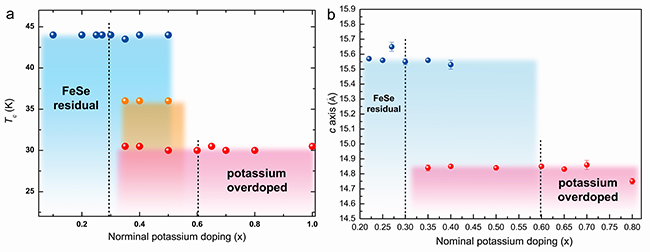 |
| Fiugre 1. (a) Tcs of KxFe2Se2(NH3)yas a function of nominal potassium content. They show abrupt rather than dome-like changes with potassium content. (b) Lattice constants c of KxFe2Se2(NH3)yvs nominal potassium content. Two distinct c values are displayed that coexist for x between 0.3 and 0.6. (Image by Prof. CHEN Xiaolong et al) |
CONTACT:
Prof. CHEN Xiaolong
Institute of Physics, Chinese Academy of Sciences
Email: xlchen@ iphy.ac.cn