


Dynamical phase transition and possible superconductivity in monolayer silicene
Date:01-04-2013 Print
Silicene, the silicon version of two-dimensional graphene lattice, is predicted to have Dirac cones in its Brillion zone similar to graphene. As a result, many novel quantum effects proposed and discovered in graphene should also be found in silicene. Silicene also has other unique characteristics such as the larger spin-orbital coupling due to its non-planar structure, which can open a significant energy gap at Dirac points, leading to observable spin quantum Hall effect. Silicene is also considered as a 2D topological insulator, whose band structure can be modulated by external electric and magnetic fields, and thus give rise to quantum anomalous Hall effect, valley-polarized metallic phases, topological phase transitions, and so on. Furthermore, silicene has advantages in manufacturing integrated devices because it is compatible with the current Si microelectronics industry
Silicene on Ag(111) surfaces exhibits numerous reconstructions, such as 3×3, 4×4, as well as √3×√3 superstructures. Among these reconstructed structures, only the √3×√3 structure of silicene has been demonstrated to have Dirac-type band structure, which means it might be closest in electronics to free-standing silicene (Phys. Rev. Lett 109, 056804(2012);Nano Lett. 12, 3507(2012)).
Recently, a research group led by Prof. WU Kehui and Prof. MENG Sheng in the Institute of Physics, Chinese Academy of Sciences have made new interesting findings concerning a dynamics structural phase transition of silicene on Ag(111) at low temperature. Employing scanning tunneling microscopy (STM), Wu et al. observed that the √3×√3 honeycomb structure of silicene starts to experience a spontaneously symmetry breaking below 40 K, and transition into two kinds of mirror-symmetric rhombic super structures (Figure 1a). Such phase transition phenomenon has never been discovered in graphene-like two-dimensional systems.
To unravel the detailed structure of silicene phases and the mechanism of the phase transition on Ag(111), they performed comprehensive first-principle calculations on √3×√3 silicene on Ag(111). Two energy-degenerated mirror-symmetrical √3 structures of silicene were identified (Figure 1b, 1c). The transition barrier between them is found to be less than 30 meV/atom (Figure 1d), indicating thermal activation can induce free and rapid transition between these two phases, which will lead to observed honeycomb structure at higher temperature. The √3 structure of silicene on Ag(111) preserves linear dispersion Dirac cones of free-standing silicene, however, the stronger buckling in √3 structure introduces a significant energy gap (~150 meV) at its Dirac point (Figure 1e), which is essential for developing silicene-based electronic devices. This work was published on Phys. Rev. Lett. 110, 085504 (2013).
In addition, Prof. WU Kehui 's group has also discovered an energy gap as large as 70meV at Fermi level of silicene at 5 K by scanning tunneling spectroscopy (STS, Figure 2a). Two apparent coherent peaks are symmetrically distributed around the gap. Temperature measurements revealed the gap is disappeared about 40 K(Figure 2b). They concluded the energy gap may be caused by superconducting states of silicene, and the evaluated critical temperature is about 40K. This is the single-element superconductor with highest critical temperature. If the superconductivity of silicene is confirmed by further experiments, this discovery will be a milestone of silicene researches. This work was published on Appl. Phys. Lett. 102, 081602(2013).
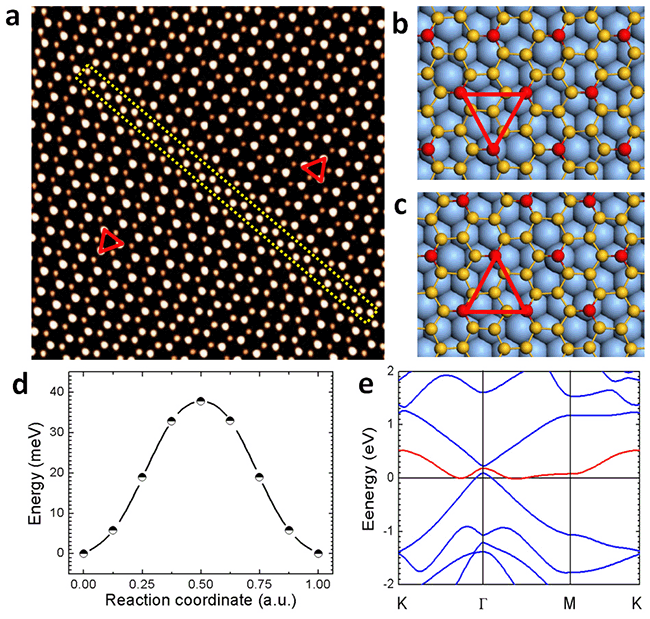 |
| Figure 1. (a) High resolution STM image of monolayer silicene at 5 K. (b), (c) Mirror-symmetrical √3×√3 reconstructed silicene structures on Ag(111) from DFT calculation. Color codes: Ag, blue; Higher Si, red; Lower Si, yellow. (d) Transition barrier between two low temperature phases. (e) Band structure of √3×√3 silicene. (Image by Prof. WU Kehui , Prof. MENG Sheng et al.) |
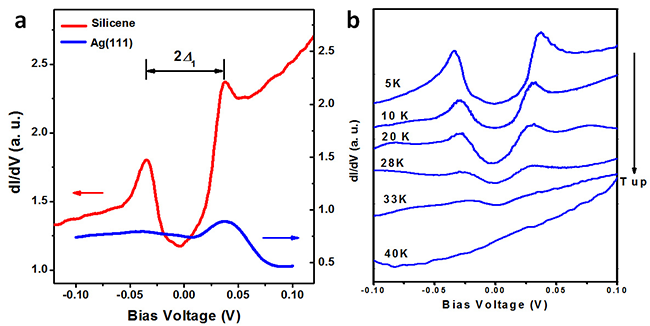 |
| Figure 1. (a) STS spectra of silicene at 5 K, a band gap of 70 meV can be observed at Fermi level. (b) STS spectra at various temperatures, where the band gap disappears at ~40 K. (Image by Prof. WU Kehui et al.) |
Prof. WU Kehui
Institute of Physics, Chinese Academy of Sciences
Email: khwu@iphy.ac.cn
Prof. MENG Sheng
Institute of Physics, Chinese Academy of Sciences
Email: smeng@iphy.ac.cn