


Researchers find A Novel Approach to Tune Magnetic Anisotropies of Fe ultrathin films on Si(111) substrate
Date:08-04-2013 Print
Magnetic anisotropy is not only the origin of long-range-magnetic-order in low dimensional system, but also plays a vital role in determining the magnetic properties for magnetically hard, magnetic soft, high-frequency magnetic materials, ultrahigh density magnetic recording media and spintronic materials. The atomically flat terraces separated by steps are generally used as templates for preparing various self-organized nanostructures, including regular arrays of nanodots, nanostripes, atomic wires and ultrathin films. Furthermore, the terraces can be employed to confine magnetic nanodot assemblies and form one dimensional (1D) quantum-well states. For these low-dimensional magnetic materials, the interplay between quantum confinement and broken symmetry often emerges novel electronic structures and magnetic properties. As a result, the magnetic anisotropy of the magnetic nanostructures can be drastically manipulated by the stepped surfaces.
Compared to metallic substrates, Si substrate is convenient to get a clean surface, and the surface morphology can be manipulated by different treating processes. From 2009, Prof. CHENG Zhaohua and coworkers from Beijing National Laboratory for Condensed Matter Physics at the Institute of Physics, Chinese Academy of Sciences reported that quasi 1D magnetic nanodot assemblies were fabricated on vicinal Si(111) surface with relatively large miscut angles (~4º). Unfortunately, the terrace width of these stepped substrates cannot be tuned easily once the miscut angle is fixed, which causes difficulty in investigating the effect of terrace width on magnetic properties by using identical substrates.
Now they adopted a novel method to tune the terrace width of Si(111) substrate by varying the direction of heating current. It was observed that the uniaxial magnetic anisotropy (UMA) of Fe films grown on the Si(111) substrate enhanced with decreasing the terrace width and superimposed on the weak six-fold magnetocrystalline anisotropy. Furthermore, on the basis of the scanning tunneling microscopy (STM) images, self-correlation function calculations confirmed that the UMA was attributed mainly from the long-range dipolar interaction between the spins on the surface. This discovery opens a new avenue to manipulate the magnetic anisotropy of magnetic structures on the stepped substrate by the decoration of its atomic steps.
This work was published on Scientific Report [Sci. Rep. 3, 1547; DOI:10.1038/srep01547 (2013).]. It was partly supported by the National Basic Research Program of China (973 program,Grant Nos. 2009CB929201, 2011CB921801, and 2012CB933102) and the National Natural Sciences Foundation of China (50931006, 11034004, and 51021061).
CONTACT:
Prof. CHEN Zhaohua
Institute of Physics, Chinese Academy of Sciences
Email: zhcheng@ iphy.ac.cn
Appendix:
http://www.nature.com/srep/2013/130326/srep01547/full/srep01547.html
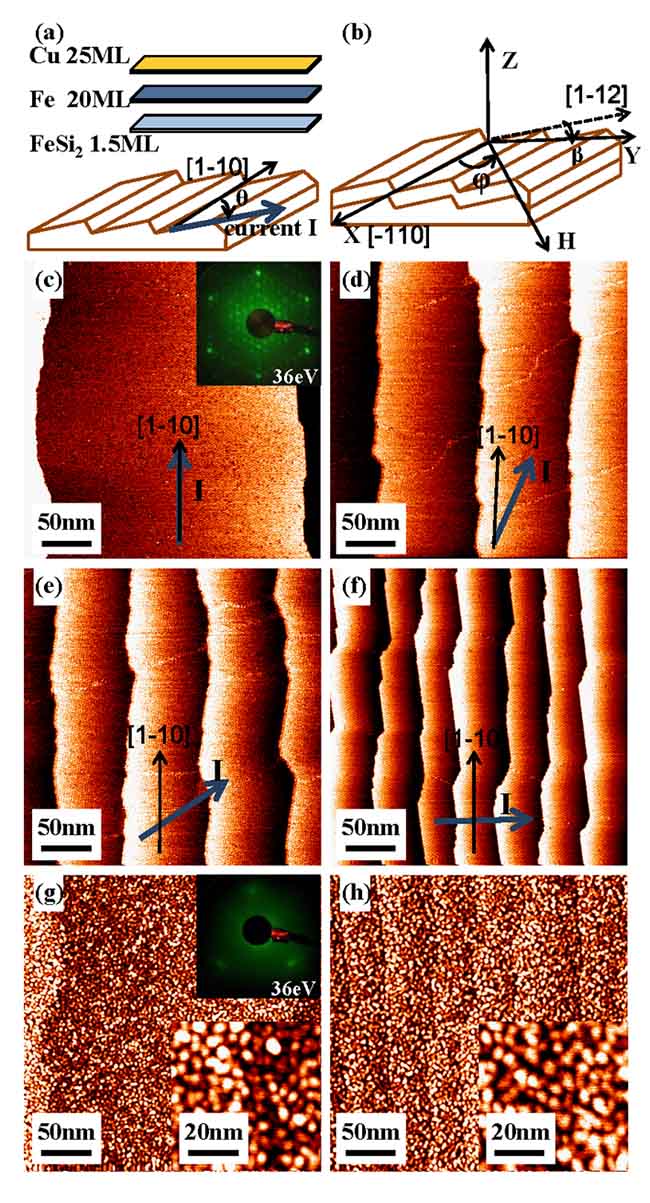 |
| Fig.1 The schematic configuration of the sample preparation and MOKE measurement, and STM images of sample surface. (Image by Prof. CHEN Zhaohua et al.) |
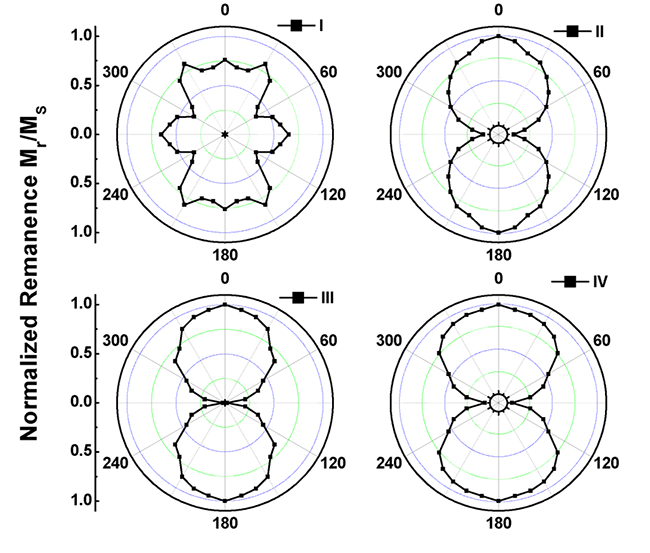 |
| Fig.2 The angular dependence of the normalized remanence Mr/Ms obtained from the experimental hysteresis loops (Image by Prof. CHEN Zhaohua et al.) |
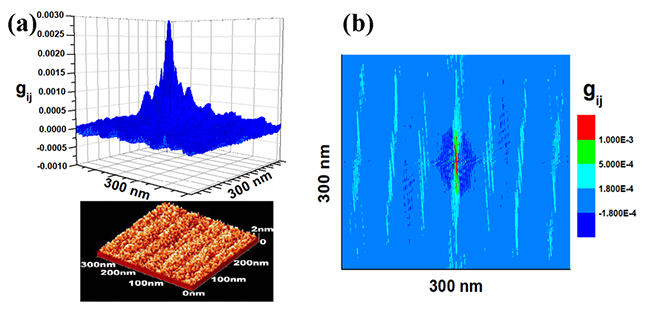 |
| Fig.3 The typical spatial and in-plane distribution of the self-correlation function (Image by Prof. CHEN Zhaohua et al.) |