


Quantum cloning machine is realized experimentally in nitrogen-vacancy center of nanodiamond
Date:22-04-2013 Print
An arbitrary quantum state cannot be cloned perfectly. This is the no-cloning theorem in quantum mechanics and quantum information science. On the other hand, we can try to clone a quantum state approximately or probabilistically. So various quantum cloning machines are proposed theoretically and realized experimentally. One important application of quantum cloning machine is to attack the quantum key distribution, which is a secure quantum communication protocol. By using this attack, we can analyze the security of the quantum key distribution.
A widely used protocol of quantum key distribution is the BB84 protocol, in which four quantum states are used to encode the classical information. The quantum cloning machine which can copy these four BB84 states is the phase-covariant quantum cloning machine which actually can copy optimally all qubits located on the equator of the Bloch sphere.
Recently, Prof. FAN Heng, Prof. PAN Xinyu and coworkers from Beijing National Laboratory for Condensed Matter Physics at the Institute of Physics, Chinese Academy of Sciences, reported an experimental realization of the phase quantum cloning in system of nitrogen-vacancy center of nanodiamond at room temperature.
The nitrogen-vacancy defect center is constituted by a nitrogen atom which replaces a carbon atom and a nearby vacancy in diamond. It provides an electronic spin-1 quantum state which can be initialized, controlled and readout, and thus it can be used experimentally for quantum information processing. It is more challenging to implement the experiment in nanodiamond than in a bulk sample because of the coherence time. However, nanodiamond shows more potential for further integration and applications. And thus the experiment is performed by using nanodimond sample. In experiment, the phases of quantum states are manipulated actively and examined exactly. All four quantum states corresponding to BB84 states are optimally cloned, the average fidelity is about 85.1% which is very close to the theoretical expectation 85.4%. Also the experimental fidelity is clearly larger than 83.3% which is the optimal fidelity for universal quantum cloning machine. The experimental shows that phase quantum cloning machines are realized successfully. And the quantum phases can be controlled with high accuracy. This provides a basis for phase-controllable quantum information devices.
This work was published on Scientific Reports [Sci. Rep. 3, 1498 (2013)]. It was supported by ‘‘973’’ programs (2009CB929103, 2010CB922904), NSFC grants (11175248, 10974251) and grants from CAS.
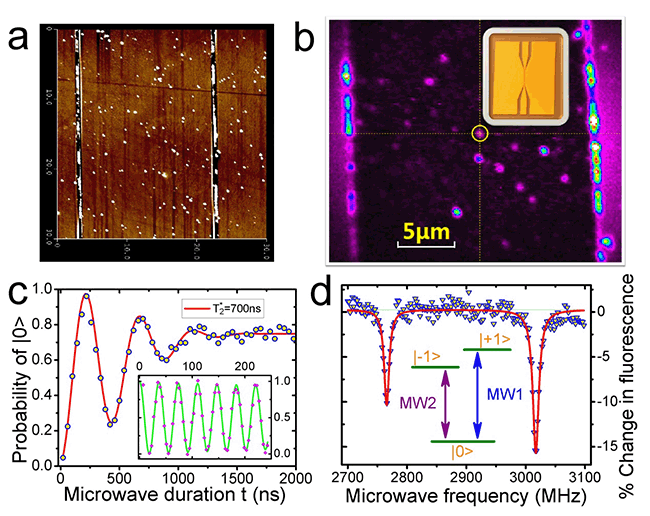 |
| Figure 1. Nanodiamond samples and the energy level structure of NV center. (Image by Prof. FAN Heng, Prof. PAN Xinyu et al.) |
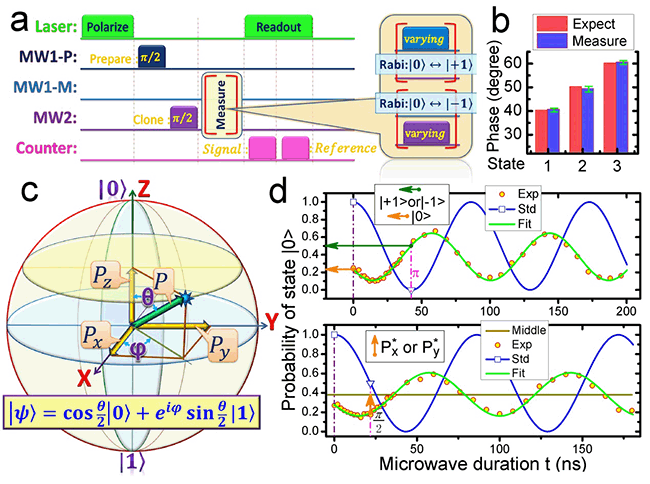 |
| Figure 2. Scheme of quantum phase cloning. (Image by Prof. FAN Heng, Prof. PAN Xinyu et al.) |
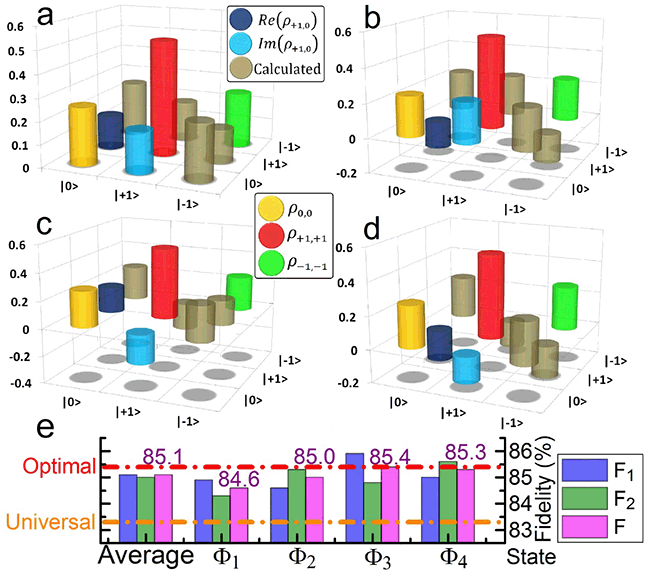 |
| Figure 3. Results for density matrices and phase cloning fidelity. (Image by Prof. FAN Heng, Prof. PAN Xinyu et al.) |
CONTACT:
Prof. FAN Heng or Prof. PAN Xinyu
Institute of Physics, Chinese Academy of Sciences.
Email: hfan@iphy.ac.cn or xypan@aphy.iphy.ac.cn