


Progress on laser-driven secondary sources: Bright betatron x-ray radiation from a laser-driven-clustering gas target
Date:08-06-2013 Print
Hard x-ray emission from femtosecond laser produced plasmas has a number of interesting applications. This kind of intense and ultrafast hard x-ray source can pose as a possible alternative to the synchrotron radiation due to its compactness and its sub-picosecond pulse duration, and is, therefore, of interest for practically using in majority of labs and hospitals. Presently, there are serious obstacles limiting this source in applications, e.g: the limited x-ray conversion efficiency (~10-5) and the spectrum contrast ratio. Therefore, the laser-driven hard x-ray source with more intense flux and higher spectrum contrast ratio is crucial for application.
Prof. CHEN Liming and coworkers from Beijing National Laboratory for Condensed Matter Physics at the Institute of Physics, Chinese Academy of Sciences made a series of progress in the laser-driven x-ray sources. In 2008, they achieved 10 folds enhancement of Kα conversion efficiency by using high contrast laser incident with solid target and significantly reduced the continuum background [Phys. Rev. Lett. 100, 045004(2008)]. And then, they present generation of intense Ar K-shell x-rays with very weak background using a small cluster target irradiated with a high contrast fs laser pulse in 2010 [Phys. Rev. Lett. 104, 215004(2010)]. The intensity of the Ar K-shell emission has been measured to be 1011 photons/J, which is strong enough for single-shot x-ray imaging. The pulse duration of this source is in the 10 fs time scale.
Besides the progress of monochromatic but uniform spatial distribution sources, this team newly made progress in laser-driven spatially coherent synchrontron (betatron) x-rays. Hard x-ray sources including the betatron x-rays from laser wakefield-accelerated electrons, have compact sizes, fs pulse duration and fs pump-probe capability. Currently the main problem with such betatron x-ray sources is the limited average flux even with ultra-intense laser pulses. Prof. Chen report ultra-bright betatron x-rays can be generated using a clustering gas target irradiated with only a few TW laser, where a forty-fold enhancement of the x-ray conversion efficiency is achieved compared to the results obtained using a gas target. They suggest the increased x-ray photon is due to the existence of clusters in the gas, which results in increased total electron charge trapped for acceleration and larger wiggling amplitudes during the acceleration. This observation opens a route to produce high betatron average flux using small but high repetition rate laser facilities.
This work was newly published on Scientific Reports [Sci. Rep. 3, 1912(2013)]. This work was supported by the National Basic Research Program of China (No.2013CBA01501 and 2013CBA01504), National key Scientific Instrument and Equipment Development Project (No. 2012YQ120047) and the NSFC.
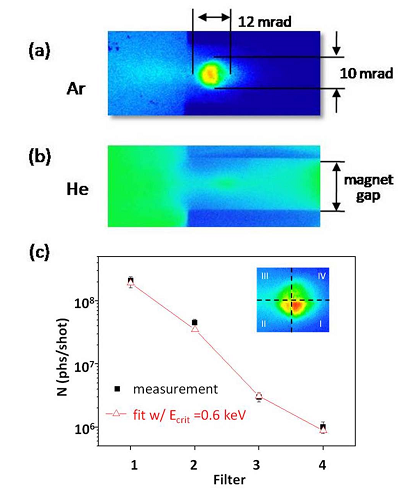 |
| Figure 1: The measured betatron emission beam characteristics from Ar clusters (a) and He gas (b). (image by Prof. CHEN Liming) |
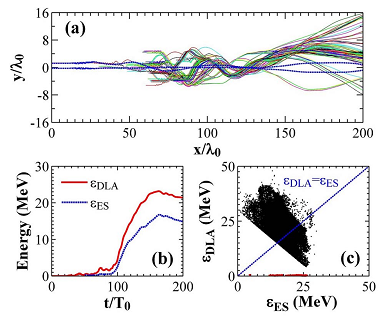 |
| Figure2. Traced electron trajectories and energy gain from simulation with a cluster target and pure gas target. (image by Prof. CHEN Liming) |
CONTACT:
Prof. CHEN Liming
Institute of Physics, Chinese Academy of Sciences
Email: lmchen@ iphy.ac.cn
http://www.nature.com/srep/2013/130529/srep01912/full/srep01912.html