


Scientists Employ Nernst Effect to Probe Local Kondo Scattering
Date:13-06-2013 Print
Kondo effect arises from the resonant spin-flip scattering of conduction electrons off a local magnetic moment. Phase coherence of Kondo scattering at low temperatures gives rise to the phenomena of heavy fermion, where the effective mass of conduction electrons is greatly enhanced by two or three orders of magnitude. A number of intriguing phenomena, including superconductivity, magnetism and non-fermi liquid behavior may emerge from a Kondo lattice system. The evolution of Kondo scattering is closely related to the formation of the heavy-fermion or other exotic ground states. Various modern experimental techniques are employed to probe the Kondo scattering and low energy excitations in such a system. Nevertheless, it appears hard to quantitatively describe the Kondo scattering process, in particular the energy dispersiveness of scattering rate..
Recently, Prof. SUN Peijie from Beijing National Laboratory for Condensed Matter Physics at the Institute of Physics, Chinese Academy of Sciences, in collaboration with Prof. F. Steglich from Max Planck Institute for Chemical Physics of Solids, reported that the local Kondo scattering process can be simply probed by a thermoelectric transport technique, i.e, the Nernst effect, which is a transverse thermoelectric signal in the presence of perpendicular magnetic field.
Following an analysis based on standard transport theory, they conclude that the Nernst effect is very sensitive to the asymmetry of Kondo scattering process. Because the anomalous Hall effect in a Kondo lattice system is also determined by the Kondo scattering, a relationship among the enhanced thermopower, the Nernst effect and the anomalous Hall effect is naturally deduced from their analysis, namely, thermopower = - Nernst coefficient/Hall mobility. By measuring the prototype Kondo lattice compound CeCu2Si2, they clearly demonstrated the applicability of this relation in heavy-fermion systems.
The significance of this work is multiple. First, it proves that the Nernst effect can act as a proper probe of local Kondo scattering as well as other exotic scattering processes. Second, it provides an evidence for the local nature of the Kondo scattering process at temperatures well below the coherence temperature. Third, this work offers a way to study the unconventional thermopower induced by asymmetric scattering process, and therefore, is expected to impact on exploring unconventional thermoelectric materials for potential applications.
This work was published on the Physical Review Letters [Phys. Rev. Lett. 110, 216408 (2013)]. It was supported by the National Basic Research Program of China (Grant No. 2012CB921701).
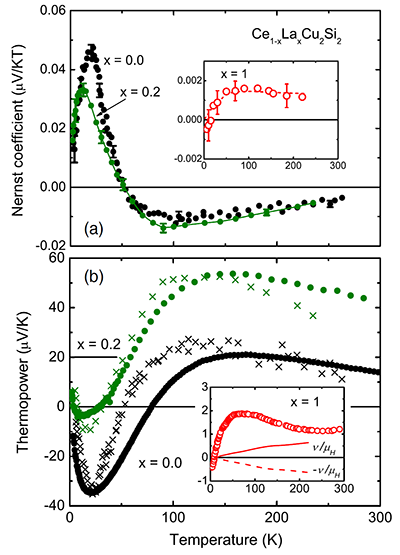 |
| (a) Nernst coefficient of CeCu2Si2, Ce0.8La0.2Cu2Si2(main panel) and LaCu2Si2(inset). Dashed line in the inset is a calculation for LaCu2Si2under the assumption of dominating acoustic phonon scattering. (b) Thermopower compared to the ratio between Nernst coefficient and Hall mobility (crosses) for the same compounds as in (a). (Image by Prof. SUN Peijie) |
CONTACT:
Prof. SUN Peijie
Institute of Physics, Chinese Academy of Sciences
Email: pjsun@ iphy.ac.cn