


Phase Diagram and Electronic Indication of High-Temperature Superconductivity at 65K in Single-Layer FeSe Films
Date:05-07-2013 Print
In 2012, Prof. XUE Qikun’s group from Tsinghua University and Prof. MA Xucun’s group from the Institute of Physics successfully grew single-layer FeSe film on the SrTiO3 substrate. By scanning tunneling microscopy (STM) measurements, they found a large energy gap that suggests a possible high superconducting critical temperature (Tc) near 77 K in this system 【Chin. Phys. Lett. 29 (2012) 037402】. This work has brought tremendous interests to the community. Prof. ZHOU Xingjiang’s group from Beijing National Laboratory for Condensed Matter Physics at the Institute of Physics, Chinese Academy of Sciences, in collaboration with XUE Qikun’s group and MA Xucun’s group, carried out first angle-resolved photoemission (ARPES) measurements on the single-layer FeSe films. They have revealed distinct Fermi surface that is the simplest among all the iron-based superconductors, and a nearly isotropic superconducting gap without nodes【Nature Communications 3 (2012) 931】. These findings have provided key insights on understanding the superconducting mechanism of the iron-based superconductors.
It is known that, in both the high temperature copper-oxide superconductors and the iron-based superconductors, superconductivity is realized by doping the parent compound with charge carriers to suppress the antiferromagnetic state. In the superconducting region, the transition temperature Tc can be optimized by carefully tuning the carrier concentration. Questions that naturally arise are whether the single-layer FeSe system will undergo similar transition from a magnetic state to superconductivity, and whether the superconductivity can be further optimized.
To address these issues, Prof. Xingjiang Zhou’s group, in collaboration with Prof. Xue and Ma’s group, have established the electronic phase diagram of the single-layer FeSe films (Figure 1). The carrier doping here is realized by a simple in-situ annealing process, and then the electronic structure and the superconducting gap were measured by ARPES. Through the evolution of the Fermi surface and band structures with doping, they find that there are two phases coexisting and competing during the annealing process. At the beginning when the doping level is low, the electronic structures of the single-layer FeSe show clear resemblance to those in the antiferromagnetic state of the BaFe2As2 parent compound. This indicates that the single-layer FeSe in this low doping case is highly likely in an antiferromagnetic phase (N phase). After annealing, another phase (S phase) emerges, which exhibits electronic structures that are distinct from those of the N phase. Further annealing leads to an increase of the S phase and a decrease of the N phase and eventually leaves only pure S phase in the annealed sample. In the meantime, the carrier concentration in the S phase increases with annealing, accompanied by the increase of the superconducting gap and the superconducting temperature. The achieved largest superconducting gap size is 19 meV and highest Tc is ~65K that is higher than the record high Tc (55K) reported in the iron-based superconductors reported so far.
The observation of an antiferromagnetic-like phase, the establishment of its electronic phase diagram, and the indication of 65K high temperature superconductivity in the single-layer FeSe, have provided key information for understanding the superconductivity mechanism of the iron-based superconductors. The wide tunability of the system across different phases makes the single-layer FeSe ideal for investigating not only the physics of superconductivity in particular, but also for studying novel quantum phenomena in general.
This work was published in【Nature Materials 12 (2013)605】 and highlighted by Nature Materials in its News and Views.
The work was supported by the National Natural Science Foundation of China (10734120) and the National Basic Research Program of China (973 program No: 2011CB921703 and 2011CB605903).
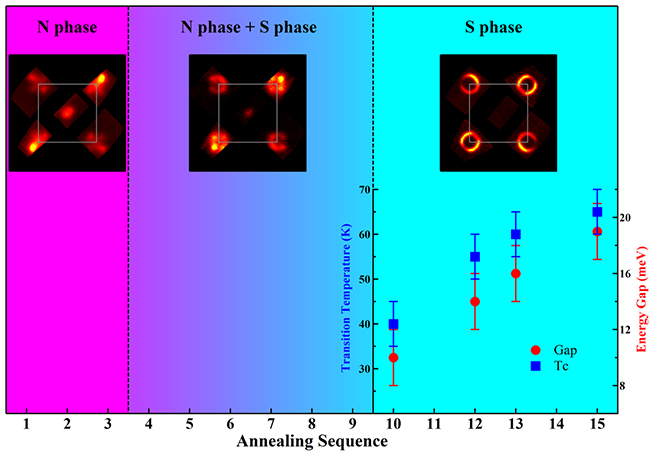 |
| Figure 1. Schematic electronic phase diagram of the single-layer FeSe film and the realization of a superconducting transition temperature Tcof 65K. Image by Prof. ZHOU Xingjiang et al.) |
Prof. ZHOU Xingjiang
Institute of Physics, Chinese Academy of Sciences
Email: xjzhou@aphy.iphy.ac.cn