


Iron-based superconductors may own a novel superconducting state
Date:19-07-2013 Print
Superconductivity arises from electron pairing. The symmetry of the quantum mechanical wave function of paired electrons is at the core of our understanding of superconductivity. For superconducting solids with a lattice that is symmetric under point reflections about its center, and whose electronic spin-orbit coupling can be ignored, the symmetry consideration boils down to both the parity of the wave function (i.e., the sign of the wave function under space inversion) and whether the total spin of the electron pair is 0 (spin singlet) or 1 (spin triplet). The existing understanding of superconductivity is that the parity must be even when the spin state is the singlet. In a recent paper by Prof. HU Jiangping [Phys. Rev. X 3, 031004(2013)] from Institute of Physics, Chinese Academy of Sciences, this understanding is fundamentally modified twith the prediction that a new form of electron pairing characterized by the combination of odd parity and the spin singlet exists for iron-based superconductors discovered only in 2008.
This prediction emerges from a fresh look at the lattice symmetry of these superconductors: What matters in the symmetry consideration should be the spatial symmetry of a single trilayer of FeAs (or FeSe) structure, the basic building block of these superconductors, rather than the square lattice from the Fe atoms that has been the focus of existing theories for pairing symmetry.
This new form of electron pairing should show a sign change under the inversion between the top and bottom As (or Se) layers of the trilayer building block. This sign change can be extracted through a phase-sensitive Josephson interferometry that links the top and bottom As (or Se) layers in bulk or thin-film materials, verifying or falsifying the theoretical prediction. This should generate considerable interest in the prediction. Moreover, the trilayer-based symmetry consideration and the new electron-pairing form are shown to be able to unify our understanding of the entire family of iron-based superconductors, including iron pnictides and iron chalcogenides, which display distinct Fermi-surface topologies. The odd parity provides a symmetry reason why the sign change should be protected in the superconducting states of both classes of materials despite their different Fermi-surface topologies.
This work is supported by the China and National Basic Research Program of China (973 program, Grant No. 2012CB821400) and the National Natural Science Foundation of China (Grant No. NSFC-1190024).
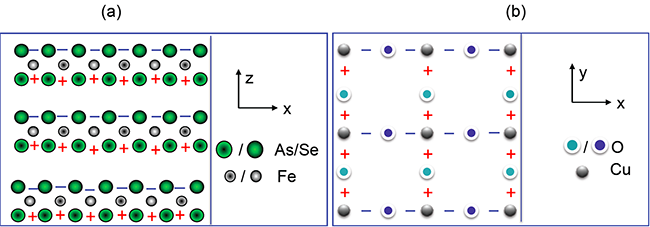 |
| Figure: Comparison of real space sign change of superconducting order parameters between cuprates and iron-based superconductors: (a) The sign change in the odd parity state of iron-based superconductors (FeSe, 111(NaFeAs) or 1111 (LaOFeAs) type of Iron-pnictides): the sign change is between the top and bottom Se/As layers. (b) The sign change in the d-wave state of cuprates: the sign change can also be viewed as between two oxygen sublattices. (Image by Prof. HU Jiangping) |