


Superconductivity in Topological Insulator Sb2Te3 Induced by Pressure
Date:05-09-2013 Print
As new states of quantum matter, topological insulators are characterized by an insulating gap in the bulk state and a robust metallic surface or edge state protected by time-reversal symmetry. Topological surface states have been theoretically predicted and experimentally observed in three-dimensional materials such as A2B3-type compounds of Bi2Se3, Bi2Te3, and Sb2Te3. Similar to topological insulators, topological superconductors are expected to have a full pairing gap in the bulk and gapless surface states that can support Majorana fermions at the edge states. Electronic excitations related to topological states, particularly Majorana fermions, are potentially useful in topological quantum computing and have thus attracted increasing attention.
The research group led by Prof. JIN Changqing, from Beijing National Laboratory for Condensed Matter Physics at the Institute of Physics, Chinese Academy of Sciences (IOPCAS), focuses on studies of topological insulators and topological superconductors, especially by using high pressure methods in the past several years. They have discovered superconductivity in the ambient structure of undoped topological compound Bi2Te3 via uisng Integrated in situ high pressure measurements, which opened up a new research way -- using physical means to study topological superconductors.
Recently, Prof. JIN Changqing’s group, systematically studied evolutions with pressure of the structure, electrical properties and topological properties of Sb2Te3. Superconductivity was found in Sb2Te3 with pressure above 4GPa while the first phase-transition pressure is above 12.9 GPa, which indicates that the pressure-induced superconductivity observed at a pressure range of 4 GPa to 12.9 GPa indeed comes from the ambient phase. Hall effects at different pressures show that there is an electronic phase transition around 7.5GPa where carriers change from the p-type at lower pressure to n-type at higher pressure.
The first principle calculations in collaboration with FANG Zong's group from the Condensed Matter Theory and Materials Computation Laboratory at IOPCAS, based on experimental measurements of the crystal lattice show that Sb2Te3 retains its Dirac surface states within the low-pressure ambient phase where superconductivity was observed, indicating a strong relationship between superconductivity and topology nature. Assuming that the bulk phase becomes an S wave superconductor by applying pressure, a proximate effect changes the surface state into a superconducting one. The superconductivity at the surface state with a well-defined Dirac cone could be topological related with p+ip wave function symmetry.
This work was published on Scientific Reports 3, 2016 (2013). The work was supported by National Natural Science Foundation of China and the National Basic Research Program.
CONTACT:
Prof. JIN Changqing
Institute of Physics, Chinese Academy of Sciences
Email: Jin@iphy.ac.cn
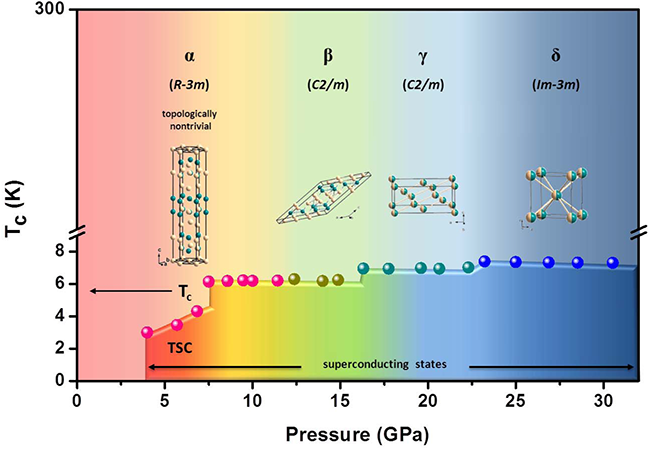 |
| Superconducting phase diagram of Sb2Te3single crystals as a function of pressure (Image by Prof. JIN Changqing et al.) |
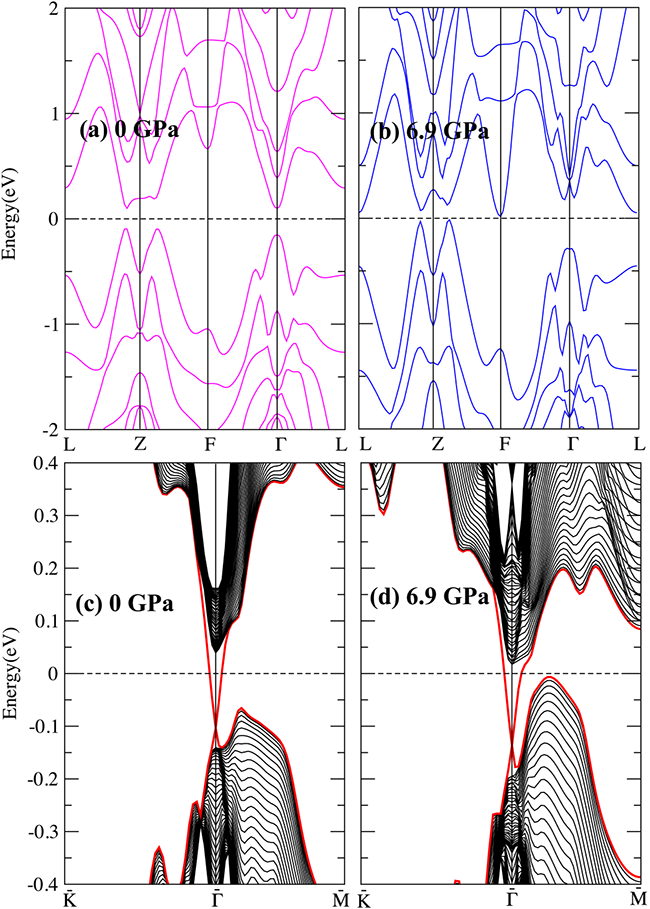 |
| Bulk (upper panels) and (111) surface states (lower panels) of Sb2Te3under 0 GPa (left panels) and 6.9 GPa (right panels) (Image by Prof. JIN Changqing et al.) |
Appendix: Superconductivity in Topological Insulator Sb2Te3 Induced by Pressure