


Researchers find A Multifunctional Intermetallic Compound With Giant Microwave Absorption and Magnetic Refrigeration
Date:25-09-2013 Print
The extensive development and use of the electronic devices have created a new kind of problem called electromagnetic interference (EMI). To suppress the serious EMI problem, it is becoming very urgent to design and fabricate the electromagnetic compatibility (EMC) devices. For achieving sufficient EMC, researchers have long been involved in exploiting microwave absorbing materials (MAMs) due to their prospective applications in electronic devices, military affairs such as airplanes, steamboats, tanks, microwave darkrooms, and even broadband electromagnetic cloaking. Two approaches, either making electromagnetic wave disappearance by interference, or absorbing electromagnetic wave effectively and converting electromagnetic energy into heat, are generally adopted for microwave loss. Unfortunately, the temperature increment and infrared radiation of MAMs due to the conversion of electromagnetic energy into heat will seriously hamper the application of microwave devices and electromagnetic stealth. Therefore, it is interesting to explore whether MAMs can be refrigerated during microwave absorption.
Both microwave absorption and magnetocaloric effect (MCE) are two essential performances of magnetic materials. Meanwhile, microwave properties of these novel magnetic refrigerants have never been reported. The high saturation magnetization is thus one of prerequisites for achieving both high frequency permeability and giant magnetic entropy change. Recently, Prof. CHENG Zhao-Hua and coworkers from Beijing National Laboratory for Condensed Matter Physics at the Institute of Physics, Chinese Academy of Sciences, reported that LaFe11.6Si1.4C0.2H1.7 has both excellent microwave absorption and giant magnetic entropy change around ambient temperature. The excellent electromagnetic wave absorption results from the large magnetic loss and dielectric loss as well as the efficient complementarity between relative permittivity and permeability. The giant MCE effect in this material provides an ideal technique for cooling the MAMs to avoid temperature increase and infrared radiation during microwave absorption. To our knowledge, the results of giant microwave absorption of -42 dB and magnetic entropy change of -20 Jkg-1K-1 in one multifunctional material have never been reported. Our finding suggests that we can integrate the microwave absorption with magnetic refrigeration in one multifunctional material. This integration not only advances our understanding of the correlation between microwave loss and MCE, but also can open a new avenue to exploit microwave devices and electromagnetic stealth.
This work was published on Scientific Report [Sci. Rep. 3, 2291; DOI:10.1038/srep02291 (2013).]. It was partly supported by the National Basic Research Program of China (973 program, Grant Nos. 2012CB933102, 2011CB921801 and 2010CB93420) and the National Natural Sciences Foundation of China (11174351, 11274357, 11034004, and 51021061).
CONTACT:
Prof. CHENG Zhao-Hua
Institute of Physics, Chinese Academy of Sciences
Email: zhcheng@iphy.ac.cn
Appendix:
http://www.nature.com/srep/2013/130726/srep02291/full/srep02291.html
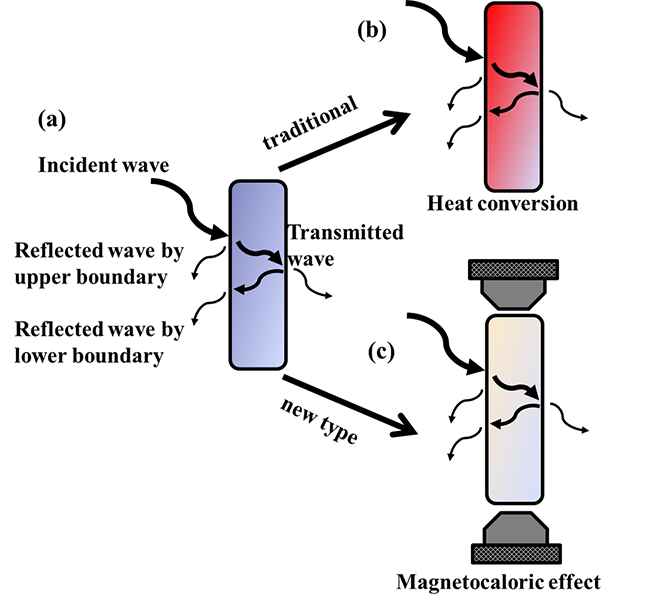 |
| Figure 1. The scheme of microwave incident on an absorbing layer. (Image by Prof. CHENG Zhao-Hua et al.) |
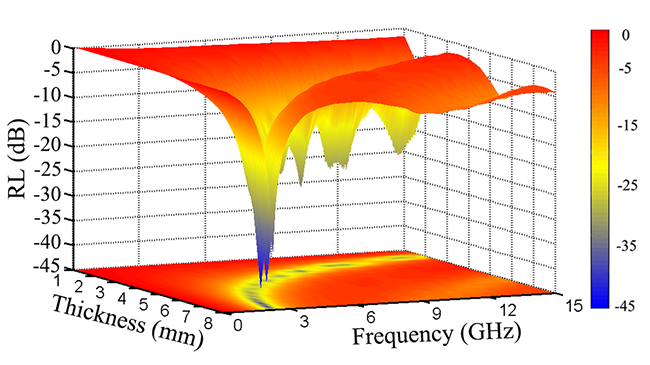 |
| Figure 2. Frequency- and thickness- dependence of refection loss (RL) for the LaFe11.6Si1.4C0.2H1.7/paraffin wax samples with different thickness. (Image by Prof. CHENG Zhao-Hua et al.) |
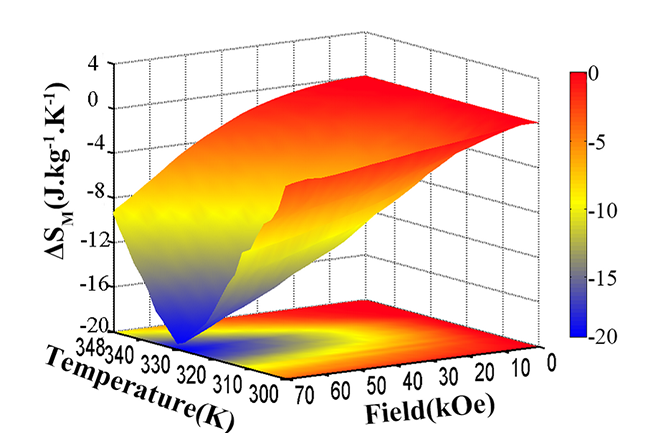 |
| Figure 3 . Magnetic entropy changeΔSMas a function of T and H of LaFe11.6Si1.4C0.2H1.7. (Image by Prof. CHENG Zhao-Hua et al.) |
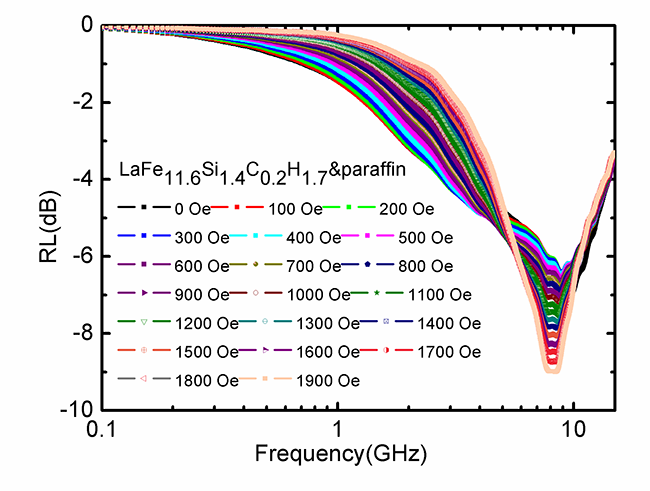 |
| Figure 4. Field-dependence of reflection loss RL of for the LaFe11.6Si1.4C0.2H1.7/paraffin wax samples with thickness of 2.0 mm. (Image by Prof. CHENG Zhao-Hua et al.) |