


Quantum Anomalous Hall Effect and Tunable Topological States in 3d Transition Metals Doped Silicene
Date:14-11-2013 Print
Recently, a research group led by Prof. LIU WuMing in the Institute of Physics, Chinese Academy of Sciences has made a progress on quantum anomalous Hall effect (QAHE) and tunable topological states in 3d transition metals doped silicene. They demonstrate that silicene decorated with certain 3d transition metals (Vanadium) can sustain a stable quantum anomalous Hall effect using both analytical model and first-principles Wannier interpolation. They also predict the quantum valley Hall effect (QVHE) and electrically tunable topological states could be realized in certain transition metal doped silicene where the energy band inversion occurs.
Silicene is an intriguing 2D topological material which is closely analogous to graphene but with stronger spin orbit coupling effect and natural compatibility with current silicon-based electronics industry. Its low energy physics can be described by Dirac-type energy-momentum dispersion akin to that in graphene, hence the inherited many intriguing properties, including the expected Dirac fermions and quantum spin Hall effect. Yet a striking difference between silicene and graphene is that the stable silicene monolayer has additional buckling degree, which accounts for the relatively large (1.55meV) spin orbit coupling (SOC) induced gap in silicene.
Researchers from Prof. LIU WuMing’s group have explored the underlying topological nontrivial states of silicene through a systematic investigation of adsorption of 3d transition metals. They demonstrate that 3d TM strongly bonding with silicene and the TM-silicene systems are strongly magnetic. From combined tight-binging model analysis and first-principles Wannier interpolation, they show that the Vanadium doped silicene hosts a stable QAHE which survives strong correlation effect of the adatom, and this system can also be half-metallic if the Fermi level is properly tuned.
Further, when applying an external electrical field, they predict the V-silicene system will give rise to another topologically nontrivial state, which supports quantum valley Hall effect (QVHE). In addition, the resulting QAHE and QVHE can be tuned directly through the electrical field, which is rather appealing for future nanoelectronics and spintronics application.
This work was published on Scientific Reports. 3, 2908 (2013).
http://www.nature.com/srep/2013/131009/srep02908/full/srep02908.html
The work was supported by National Natural Science Foundation of China and the National Key Basic Research Special Foundation of China.
CONTACT:
Prof. LIU WuMing
Institute of Physics
Chinese Academy of Sciences
Email: wmliu@iphy.ac.cn
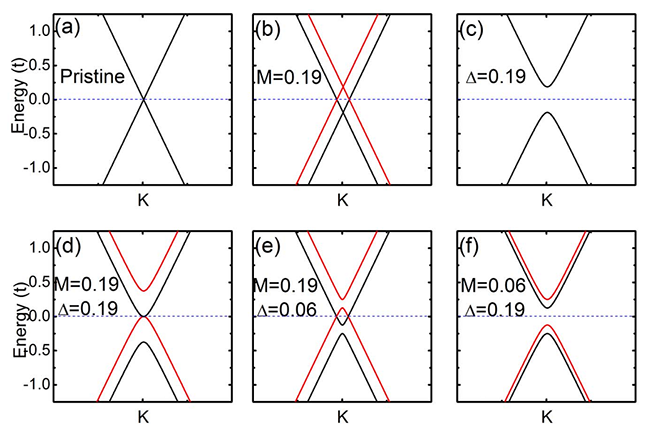 |
| Figure 1 The evolution of band structure around valley K from the interplay between exchange field M and staggered potential ∆ (in unit of t). The red (black) lines are for the majority (minority) spin. (a). The band structure of pristine silicene with perfect Dirac-like energy dispersion. (b). The spin degeneracy is lifted when only exchange field M is turned on. (c). The system becomes insulating with the valence and conduction bands twofold degenerated when only staggered potential ∆ is added. (d). When M=∆, there always exists a degenerate point right at the Fermi level. (e). When M>∆, the two spin subbands near Fermi level cross, resulting a circular Fermi surface. (f). When M<∆, the system enters insulating state. (Image by Prof. LIU’s group) |
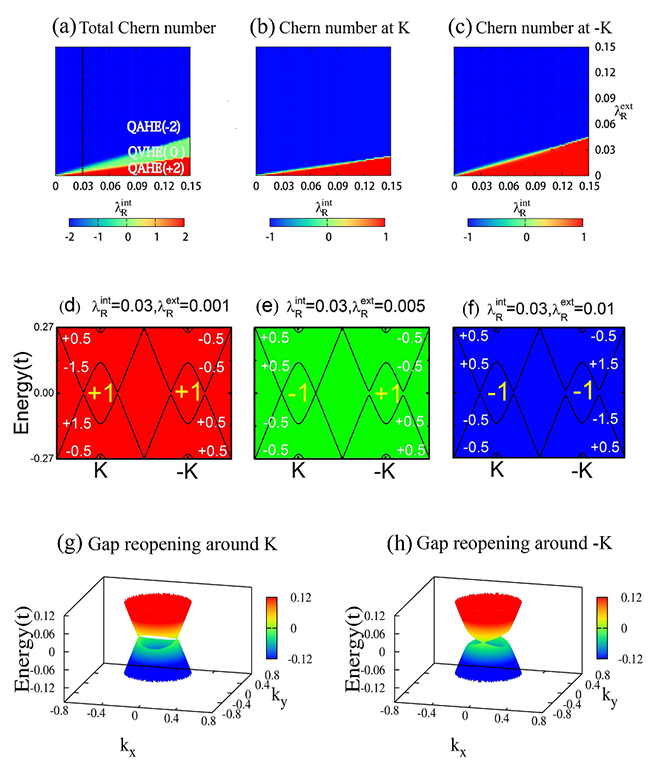 |
| Figure 2 The transition of Chern number by tuning extrinsic Rashba and intrinsic Rashba spin-orbit coupling (in unit of t). (a) Three topological nontrivial states, QAHE(2), QVHE(0) and QAHE(-2) with Chern number +2, 0, and -2, can be obtained from different combination of extrinsic Rashba and intrinsic Rashba spin-orbit coupling. (b) and (c) represent the variation of Chern number at K and -K. (d), (e) and (f) depict the band structure along ky=0 line in BZ for the three topological states (QHE(2), QVHE(0) and QHE(-2)) in (a). (g) and (h) show the gap closing around K and -K. They are the transition states from QAHE(+2) to QVHE(0) and from QVHE(0) to QAHE(-2), respectively. (Image by Prof. LIU’s group) |
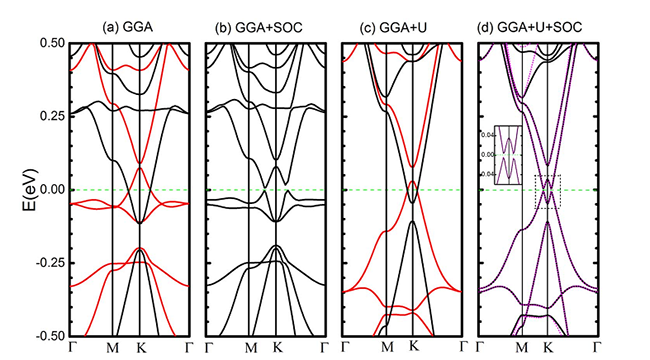 |
| Figure 3 The band structures of V doped silicene.(a) The band structures of V doped silicene from GGA ((a1)-(a2)) and GGA+U ((a3)-(a4)), respectively. The red (black) color in (a1) and (a3) correspond to majority spin (minority spin) subbands. After including spin-orbit coupling (SOC) effect, a gap is opened at the Fermi level ((a2) and (a4)). In (a4), the band structure from Wannier interpolation is also shown in pink dashed lines. (Image by Prof. LIU’s group) |
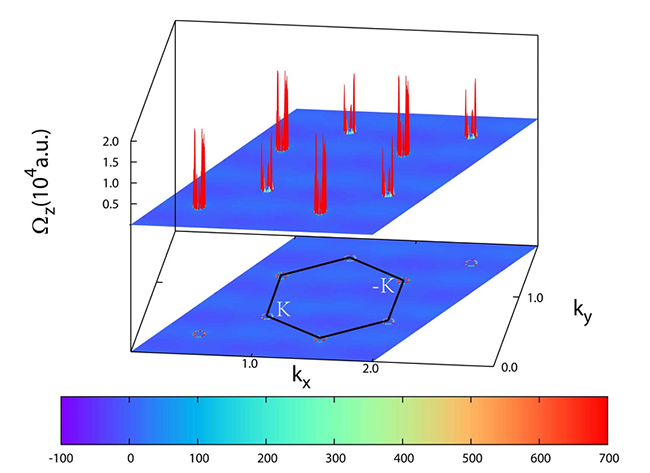 |
| Figure 4 The distribution of Berry curvature of all occupied states in V doped silicene from GGA+U+SOC. The first Brillouin zone is marked out with black hexagon. The small red circles in the projection drawing represent the most non-zero values of Berry curvature. (Image by Prof. LIU’s group) |