


Pressure-induced superconductivity and its scaling with doping-induced superconductivity in complex compound Ca10(Pt3As8)(Fe2As2)5
Date:18-04-2014 Print
The Ca10(Pt3As8)(Fe2As2)5 compounds is parent compound of new type of iron pnictide superconductors whose structures can be described as replacing alternatively the Fe2As2 layers in the CaFe2As2 (Ca-122) unit cell with Pt3As8 intermediary layers (so called skutterudite layer). Apparently, the 10–3–8 compound is special due to its unique intermediary layers with semiconducting character, no other examples of this are known in the pnictide superconducting literature.
Recently, Prof. SUN Liling and Ph.D student GAO Peiwen etc. from Prof. ZHAO Zhongxian’s research team of National Lab for Superconductivity in Institute of Physics, Chinese Academy of Science, systematically investigated the 10-3-8 compound using a house-build system integrated with high pressure, low temperature and magnetic field, in collaboration with Prof. R. J. Cava and Dr. N. Ni from Princeton University. They find that pressure can induce emergence of superconductivity in the 10-3-8 compound after its long-range AFM order is completely suppressed.
The temperature-pressure phase diagram obtained shows that a superconducting dome with maximum Tc of 8.5 K at 4.1 GPa lies in the pressure range of 3.5–7 GPa. X-ray diffraction experiments performed at the Shanghai Synchrotron Radiation Facility indicates that no pressure-induced structural phase transitions are observed for the pressure range investigated. Scaling the changes in superconductivity and carrier concentration in pressurized and doped 10-3-8 compound reveals obvious similarities and dramatic differences, demonstrating the presence of different mechanisms of developing and stabilizing superconductivity in these two cases.
They find that the pressure/doping-temperature phase diagram of the 10–3–8 compound is different from that of other known iron pnictide (e.g.122-type) systems, which present a coexistence region of AFM phase and superconducting phase. These experimental results may provide important information for further investigations of both theoretical and experimental aspects on the superconductivity of the iron-based superconductors. This work was published in Advanced Materials, 26, 2346-2351 (2014). This research was supported by National Natural Science Foundation of China, 973 projects and Chinese Academy of Sciences.
link: http://onlinelibrary.wiley.com/doi/10.1002/adma.201305154/pdf
CONTACT:
Prof. SUN Liling
Institute of Physics
Chinese Academy of Sciences
Email: llsun@iphy.ac.cn
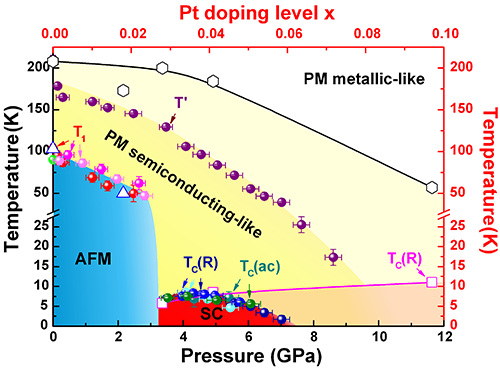 |
| Fig 1. Temperature-pressure electronic phase diagram and scaled temperature-doping phase diagram for the 10–3–8 comound, the solid symbols represent the results obtained from high pressure measurements, and the open symbols represent the results of doping (Image by IOP). |
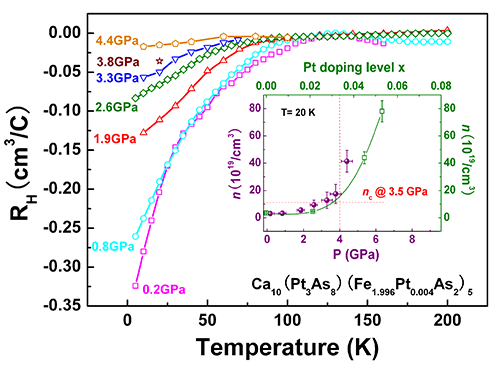 |
| Fig 2. Hall coefficient as a function of temperature obtained at different pressures and pressure dependent of carrier concentration (n) for the undoped 10–3–8 compound (inset) (Image by IOP). |