


Simultaneous Broadband Generation of Second and Third Harmonics Realized From Chirped Nonlinear Photonic Crystals
Date:26-09-2014 Print
Ultra-broadband laser sources are highly desirable in a wide variety of modern science disciplines ranging from physics, chemistry, and materials science to information communications and processing. Broad-bandwidth and high conversion-efficiency second-harmonic generation (SHG), third-harmonic generation (THG), higher-order harmonic generation, and various frequency-mixing and parametric-conversion processes have all provided fascinating routes toward the considerable expansion of the spectral range of laser sources.The quasi-phase-matching (QPM)technique is an effective approach to compensate for phase mismatch in nonlinear frequency conversion processes. Recently, the group led by Prof. Zhi-Yuan Li from Laboratory of Optical Physics, Institute of Physics, Chinese Academy of Sciences, realized simultaneous broadband generation of second and third harmonics with high conversion efficiency in a chirped periodically poled lithium niobate (CPPLN) nonlinear photonic crystal which supports multiple orders of quasi-phase matching with finite bandwidth.
The CPPLN nonlinear crystal has a modulation period of nonlinear susceptibility that varies along the propagation direction. As illustrated in Fig. 1(a), the length of the negative domains in the CPPLN structure, , is fixed to a certain value, and a chirped poling period is obtained by varying the lengths of the positive domains. We fabricated the CPPLN samples using the electric poling technique at room temperature. Fig. 1(b) presents a microscopic image of a typical CPPLN sample.Numerically, we calculated the reciprocal lattice vector (RLV) composition of the structure by applying a Fourier transform to the domain-structure position function.The RLVs curve for the CPPLN structure is plotted alongside the phase-mismatch curves for both SHG and SFG in Fig. 1(c). It shows that the CPPLN structures have four continuous bands of RLVs with high effective nonlinear susceptibility. In addition, the phase-mismatching of SHG (FW+FW) and SFG (FW+SHW) can be compensatedsimultaneously because of the fulfillment of the QPM condition, leading to simultaneous broadband SHG and THG from this CPPLN structure.
The SHG and THG of the CPPLN samples were measured using a tunable optical parametric oscillator (OPO) pumped by a 1064 nm Nd: YAG laser, as shown in Fig. 2-3.The CPPLN realizes simultaneous broadband generation of secondharmonics (bandwidth100nm, efficiency>30%) and third harmonics (bandwidth75nm, efficiency>2%).The CPPLN scheme offers a promising approach forthe construction of short-wavelength laser sources and enables the generation of the three primary colors—red, green, and blue—from a single crystal, which may have potential applications in large-screen laser displays.This work was published recently onLight: Science & Applications [Vol. 3, e189 (2014),IF=8.5].
The project was supported by the National Science Foundation, the Ministry of Science and Technology of China, and the Chinese Academy of Science.
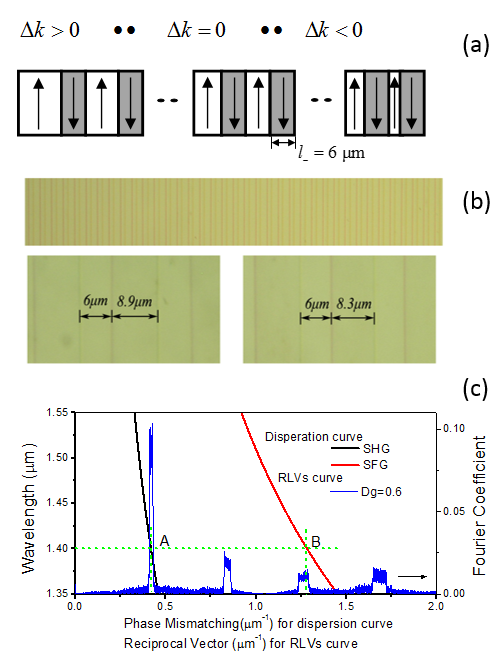 |
| Figure 1.Principle of the CQPM scheme in CPPLN for broadband SHG and THG. |
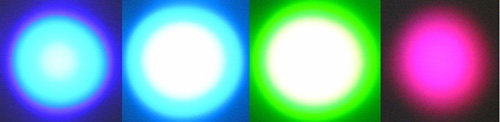 |
| Figure 2.Photographs of several SHW beam spots. |
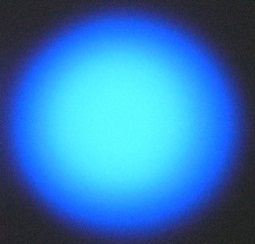 |
| Figure 3.Photograph of THW beam spot. |