


Ultrafast Dynamics Probes Single-Layer FeSe/SrTiO3 Interface Superconductivity
Date:25-03-2016 Print
Since the discovery of single-layer FeSe/SrTiO3 interface superconductivity in 2012 [Chin. Phys. Lett. 29, 037402 (2012)], its superconducting (SC) mechanism aroused great interests. Its transition temperature (Tc) is much higher than that of bulk FeSe and, while available investigations have shown that its electronic structure is much different from that of bulk FeSe, how much the electron-phonon coupling is different from that within bulk FeSe remains an unresolved puzzle. Besides of this, the SC Tc values show difference between the capped and in situ samples. It is not entirely clear how a capping layer reduces the Tc value [Nat. Phys. 10, 892 (2014)]. Investigating the FeSe/SrTiO3 interface superconductivity using ultrafst optical spectroscopy enables probing the system by observing the non-equilibrium states. Especially, the e-phonon coupling strength can be obtained by observing the quasiparticle lifetime, which is inaccessible to most of the other methods.
Recently, Professor Jimin Zhao at the State Key Laboratory for Surface Physics, Institute of Physics, CAS/Beijing National Laboratory for Condensed Matter Physics collaborated with Academician Qi-Kun Xue/Professor Xucun Ma group in Tsinghua University on investigating the system. From the time-resolved ultrafast optical spectroscopy weak detection results (Fig. 1), they clearly observed SC phase transition in the single-layer FeSe/SrTiO3 (Fig. 2&3), with Tc = 68 (-5/+2) K. In Fig. 1, the quasiparticle dynamics shows a transition around 70 K. In Fig. 2, the phonon-bottleneck effect is clear, which demonstrates an even clearer feature of SC transition at 68 K. Fig. 3 contains the quantitative analysis, showing a simultaneous change in both the amplitude and lifetime around 68 K (Fig. 3c&d). This evidences a SC transition, according to the non-equilibrium state microscopic dynamical balance dipicted by the Rothwarf-Taylor Model. The SC gap is obtained to be Δ(0) = 20.2 ± 1.5 meV. From the fast component quasiparticle lifetime shown in Fig. 3b, they obtained the e-phonon coupling as λ = 0.48, which is three times of the bulk FeSe obtained using the same method. Further, they also observed a coherent acoustic phonon branch in the 2 unit cell thick FeTe capping layer, which provides an additional decay channel for the pairing phonons (or other glues) at the interface (or substrate). This provides a plausible explanation for the afore-mentioned question: the pairing glue is reduced in amount or lowered in energy, thus reducing the Tc.
This is the first time to observe a SC phase transition in a single-atomic system using ultrafast spectroscopy. Single layer atoms provide merely very weak signals, aggravated by the strong disturbance from the capping layer noise. They overcame the challenges and optimized the number of capping layers, ultimately revealing the definite characteristics of SC transition. This work demonstrated a few advantages of using ultrafast spectroscopy to investigate strongly correlated systems: time-resolved ultrafast dynamics, non-contact non-invasive measurements, phase transition in a single-layer/interface system, as well as properties realted to the pairing bosons.
The study entitled “Ultrafast Dynamics Evidence of High Temperature Superconductivity in Single Unit Cell FeSe on SrTiO3” was published on Physical Review Letters 116, 107001 (2016).
This study was supported by the National Natural Science Fundation of China (Grants No. 11574383, 11274372, and 11374336), the Ministry of Science and Technology of China (Grants No. 2012CB821402 and 2015CB921001), and the Chinese Academy of Sciences (Grant No. GJHZ1403).
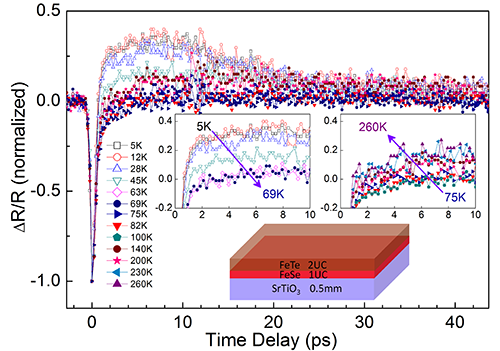 |
| Fig.1 Ultrafast dynamics of single layer FeSe/SrTiO3at different temepratures. A transition shows up at around 70 K. (Image by Institute of Physics) |
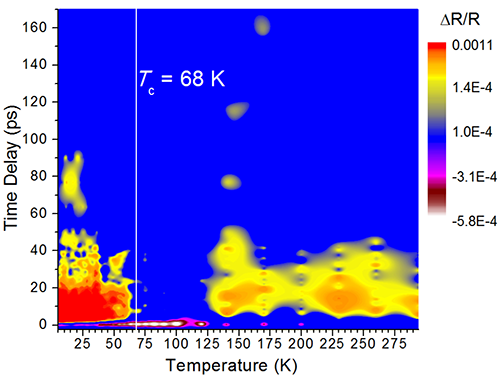 |
| Fig.2 Qualitative evidence of the SC transition. (Image by Institute of Physics) |
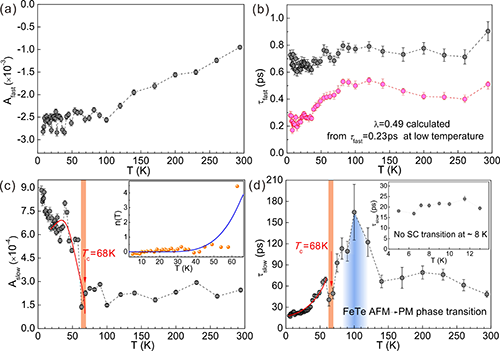 |
| Fig.3 Quantitative evidence of the SC transition: simultanious changes in the amplitude and lifetime in the slow component. (Image by Institute of Physics) |
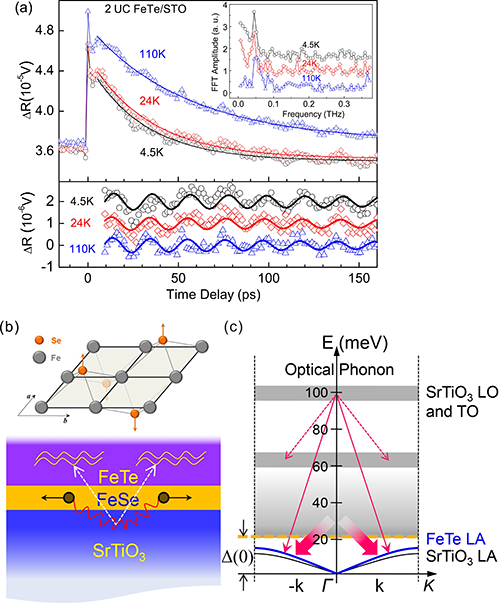 |
| Fig. 4 Coherent acoustic phonon in the capping layer, which forms an extra decay channel for the pairing glue in the interface/substrate and results in the reduction ofTc. (Image by Institute of Physics) |
Contact:
Institute of Physics
ZHAO Jimin
Email:jmzhao@iphy.ac.cn
Key word:
Ultrafast dynamics; Interface superconductor; Single-layer FeSe; e-ph coupling; Coherent phonon
Abstract:
Ultrafast spectroscopy of the single-layer FeSe/SrTiO3 interface superconductor has been investigated, revealing a Tc = 68 (+5/-2) K, a gap Δ= 20 meV, and an e-ph coupling strength of λ = 0.48. A coherent acoustic phonon mode was also observed, causing the reduction of Tc by forming an extra decay channel to the pairing glues.