


Circumventing the Fermion Sign Problem: Researchers Establish a Nonequilibrium Approach to Quantum Criticality
Date:09-01-2026 Print
For decades, physicists have faced a formidable barrier in their quest to understand quantum many-body systems: the fermion sign problem. Rooted in the fundamental rules of quantum mechanics, this problem leads to exponential computational complexity in Quantum Monte Carlo (QMC) simulations of interacting fermions. Consequently, it has long hindered the investigation of quantum many-body physics across diverse disciplines, from condensed matter physics to high-energy physics and quantum chemistry.
A research team led by Associate Professor LI Zi-Xiang from the Institute of Physics (IOP) of the Chinese Academy of Sciences and Associate Professor YIN Shuai from Sun Yat-sen University has recently developed a novel methodology to mitigate this challenge. By analyzing short-time nonequilibrium dynamics, the team has established an efficient pathway to characterize quantum criticality without the limitations imposed by long-time simulations. The study, titled "[Preempting fermion sign problem: Unveiling quantum criticality through nonequilibrium dynamics in imaginary time](https://www.science.org/doi/10.1126/sciadv.adz4856)," was recently published in Science Advances.
In the conventional QMC paradigm, reaching a system's ground state requires an extensive evolution in "imaginary time." This process is particularly problematic near quantum critical points, where the system undergoes a phase transition. As the evolution progresses, the fermion sign problem causes numerical noise to grow exponentially, typically rendering the results indistinguishable from noise before equilibrium is achieved.
The research challenged the conventional wisdom that nonequilibrium dynamics are inherently more difficult to analyze than equilibrium states. Instead, the study demonstrates that the early stages of nonequilibrium relaxation contain sufficient information to identify critical behavior. Within this short-time window, the fermion sign problem remains sufficiently suppressed, permitting the extraction of accurate phase diagrams and critical exponents before numerical instability dominates the simulation.
Utilizing this nonequilibrium framework, the researchers investigated the Hubbard model hosting SU(3)-symmetric Dirac fermions—a system previously considered computationally intractable due to the severity of the sign problem. The team successfully mapped the system's quantum phase diagram for the first time, revealing a continuous transition between a Dirac semi-metal and an SU(3) antiferromagnetic phase. Notably, their findings identified an unconventional Gross-Neveu universality class, providing new insights into the nature of Dirac fermions and critical phenomena.
The study was supported by the National Natural Science Foundation of China, the Science and Technology Projects in Guangdong Province and in Guangzhou City.
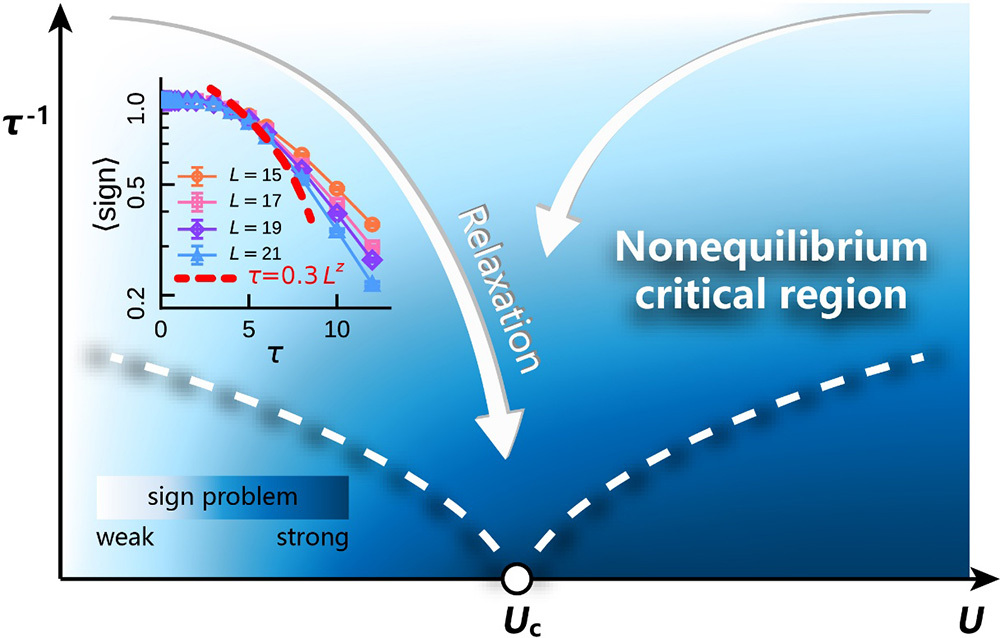
Scheme of preempting sign problem to probe quantum criticality via short-time critical dynamics. Scaling behaviors governed by the quantum critical point are reflected in the short-time stage, in which the sign problem is still weak as shown in the inset. (Image by Institute of Physics)
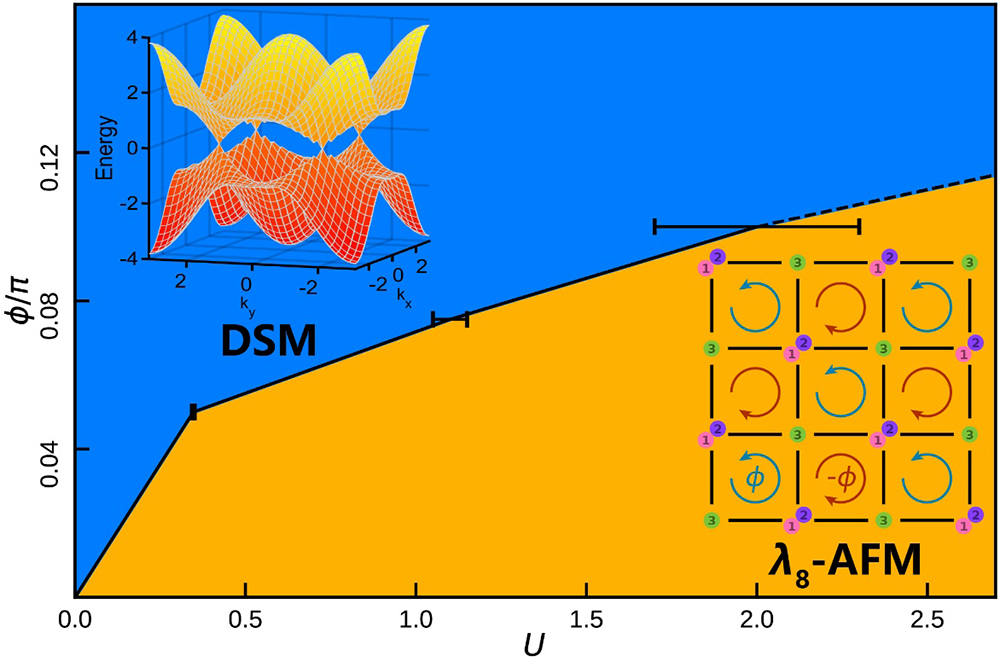
Phase diagram of the SU(3) Hubbard model detected by short-imaginary-time dynamics. Insets show the energy spectra of DSM state and sketch of λ8-AFM order. (Image by Institute of Physics)
Contact:
Institute of Physics
LI Zi-Xiang
Email:zixiangli@iphy.ac.cn
Key words:
Sign problem; Quantum Monte Carlo; nonequilibrium dynamics; quantum criticality; Gross-Neveu universality class.
Abstract:
Researchers from the Institute of Physics of the Chinese Academy of Sciences and Sun Yat-sen University have proposed a new framework to overcome the notorious fermion sign problem. By leveraging nonequilibrium dynamics, they successfully unveiled the exotic quantum criticality of the SU(3) Hubbard model, identifying an unconventional Gross-Neveu universality class.