


Scientists developed a phenomenological two-fluid framework to understand emergent states in heavy electron materials
Date:10-12-2012 Print
Heavy electron materials provide a useful prototype for exploring the underlying mechanism of unconventional superconductivity and new magnetism. These materials contain a periodic lattice of localized f-electrons that are in collective hybridization with conduction electrons to give rise to various new quantum states of matter. Recently, Prof. YANG Yi-feng from the Institute of Physics, Chinese Academy of Sciences, in collaboration respectively with Prof. David Pines and Prof. Nick Curro from the University of California, Davis, developed a phenomenological two-fluid framework that may help our understanding of these emergent phenomena. [PNAS 109, 18241 (2012)]
In the two-fluid model, the complex cooperative behavior of the many-body heavy electron system is approximately described by two coexisting fluids: an itinerant heavy f-electron Kondo liquid induced by collective hybridization and a renormalized spin liquid formed by the residual localized f-electrons. The Kondo liquid exhibits logarithmic temperature dependence and represents a new exotic quantum state of matter. [PNAS 109, E3060 (2012)]
The relative importance of the two fluids in real materials is quantified by a single parameter, f0, called the hybridization effectiveness: For strong hybridization (f0>1), all localized f-electrons become itinerant at a finite temperature, accompanied by a Fermi surface reconstruction; while for weak hybridization (f0<1), a small fraction of localized f-electrons persist and get magnetically ordered below a reduced transition temperature. This simple picture leads to a new phase diagram (fig. 1) that connects the high temperature heavy electron emergence and the low temperature ordered states, as well as a number of theoretical predictions (fig. 2 & fig. 3) that are in good agreement with experiment. [PNAS 109, E3067 (2012)]
This work was supported by NSF-China and the Chinese Academy of Sciences.
In the two-fluid model, the complex cooperative behavior of the many-body heavy electron system is approximately described by two coexisting fluids: an itinerant heavy f-electron Kondo liquid induced by collective hybridization and a renormalized spin liquid formed by the residual localized f-electrons. The Kondo liquid exhibits logarithmic temperature dependence and represents a new exotic quantum state of matter. [PNAS 109, E3060 (2012)]
The relative importance of the two fluids in real materials is quantified by a single parameter, f0, called the hybridization effectiveness: For strong hybridization (f0>1), all localized f-electrons become itinerant at a finite temperature, accompanied by a Fermi surface reconstruction; while for weak hybridization (f0<1), a small fraction of localized f-electrons persist and get magnetically ordered below a reduced transition temperature. This simple picture leads to a new phase diagram (fig. 1) that connects the high temperature heavy electron emergence and the low temperature ordered states, as well as a number of theoretical predictions (fig. 2 & fig. 3) that are in good agreement with experiment. [PNAS 109, E3067 (2012)]
This work was supported by NSF-China and the Chinese Academy of Sciences.
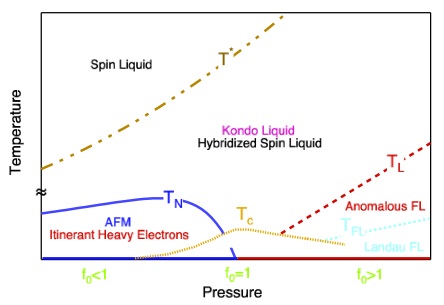 |
| Fig. 1: A new phase diagram proposed in the two-fluid model. The f-electrons are fully localized above T* and exhibit two-fluid behavior at intermediate temperatures. At very low temperatures, they either get magnetically ordered (f0<1), or become a Fermi liquid (f0>1) accompanied by a Fermi surface reconstruction at TL.Around the quantum critical point (f0=1), the itinerant Kondo liquid may condense into unconventional superconductivity or other ordered states.(Image by YANG Yi-feng et al) |
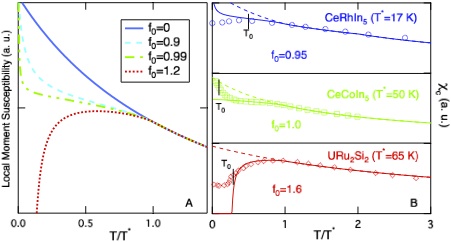 |
| Fig. 2: Comparison of the magnetic susceptibility between theoretical prediction and experiment for CeRhIn5(antiferromagnet, f0<1), CeCoIn5(d-wave superconductor, f0~1) and URu2Si2(an itinerant 5f compound with a “hidden” order ground state, f0>1). (Image by YANG Yi-feng et al) |
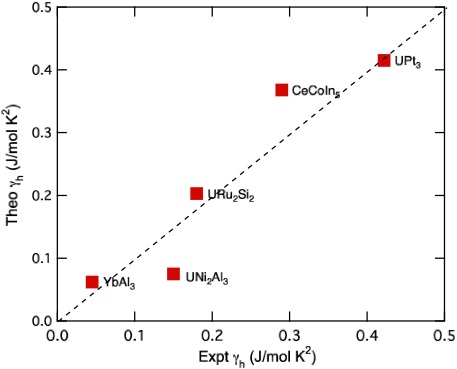 |
| Fig. 3: Comparison of the specific heat coefficient predicted by the two-fluid model to experiment in a number of heavy electron compounds. (Image by YANG Yi-feng et al) |