


Electron Coherence in MoS2 Induced by Spatial Self-Phase Modulation
Date:21-09-2015 Print
Generating electron coherence in quantum materials is essential in optimal control of many-body interactions and correlations. However, this is nontrivial in that most sophisticated electronic experimental methods are non coherent or cannot be used to induce and detect collective states. Alternatively, coherent light-matter interaction constitutes a natural (sometimes unique) way to convey the intrinsic coherence of light to certain quantum materials. The specific way of light-matter interaction, as well as the particular electronic property of the material, is pivotal to the successful conveyance of the coherence.
Recently, Associate Professor Jimin Zhao and Professor Sheng Meng from Institute of Physics, Chinese Academy of Sciences observed the emergence of electron coherence in a gapped quantum material, MoS2, by using coherent spatial self-phase modulation (SSPM) (a 3rd-order nonlinear optical property). Intuitively, although initially electrons in separate MoS2 flakes are completely independent and out-of-phase, the phases of their electronic wavefunctions are entirely locked by the incident ultrafast light pulses after the light-matter scattering (Fig. 1A). This is because each of them is induced to be consistent with the phase of the ultrafast light pulse. This coherence generation is an emergent collective phenomenon, which can be well described by a Wind-Chime Model that they proposed. The generation of the (nonlocal ac) electronic coherence is verified by the time need for the far field ring pattern formation (Fig. 1B & 1C).
By observing gap-dependent SSPM at different wavelength excitation (Fig. 2 & 3A), the researchers discovered that this way of inducing electron coherence is a ubiquitous property of two-dimensional layered quantum materials. In this first investigation of below-gap SSPM, mechanisms including the two-photon SSPM have been proposed and verified (Fig. 3B & 3C).
Significantly, the researchers experimentally demonstrated that this nonlocal ac electron coherence can be harnessed to realize two-color all-optical switching with superb performances (Fig. 4). The switching beam is able to control the phase of the strong signal beam, a small change in the switching intensity will result in the shift of the strong signal pattern in real space, thus realizing weak-control-strong switching. This the first demonstration of all-optical switching based on SSPM, which endows prosperous prospect for 2D layered quantum materials in photonics applications.
This study entitled “Emergence of electron coherence and two-color all-optical switching in MoS2based on spatial self-phase modulation” was published on Proceedings of the National Academy of Sciences of the United States of America (PNAS). See link http://dx.doi.org/ 10.1073/pnas.1504920112
The study was supported by the National Basic Research Program of China, the National Natural Science Foundation of China, and the External Cooperation Program of the Chinese Academy of Sciences.
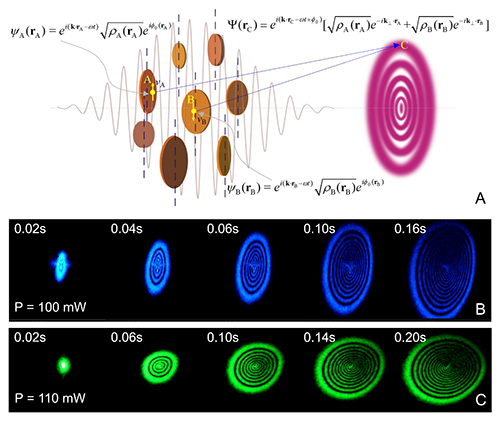 |
| Fig.1 Wind-chime model and the emergence of nonlocal ac electron coherence. (Image by Institute of Physics) |
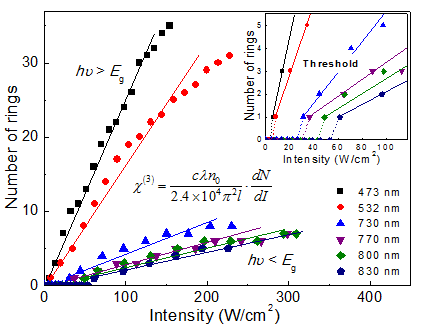 |
| Fig.2 Wavelength-dependence direct measurement of χ(3)and its bandgap dependence. (Image by Institute of Physics) |
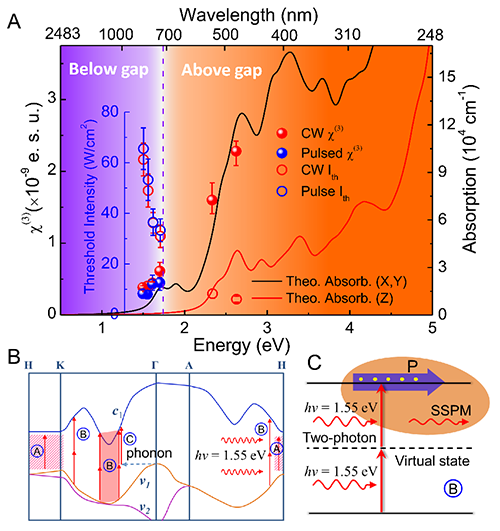 |
| Fig.3 Bandgap-dependent χ(3)and Ith and the SSPM mechanisms. (Image by Institute of Physics) |
 |
| Fig.4 Two-color all-optical switching based on SSPM. (Image by Institute of Physics) |
Contact:
Institute of Physics
ZHAO Jimin
Email:jmzhao@iphy.ac.cn
Institute of Physics
MENG Sheng
Email: smeng@iphy.ac.cn
Key words:
Electron coherence; spatial self-phase modulation; emergent phenomena; transition metal dichalcogenide; optical switching
Abstract:
Electron coherence has been established successfully in MoS2 flakes by using spatial self-phase modulation and a Wind-Chime Model is proposed to describe this emergent collective phenomena. Gap-dependent χ(3) has been obtained directly in the SSPM experiment and the physics mechanisms have been analyzed, demonstrating a ubiquitous property for 2D layered quantum materials. Furthermore, two-color all-optical switching based on SSPM has been realized for the first time, whose superb performances endow promising prospects for layered quantum materials in photonics applications.