


Scientists Revealed the Structure and Evolutionary Strategy of the Euglena gracilis Photosystem I
Date:05-03-2026 Print
A research team co-led by Associate Professor Yumei Wang (Institute of Physics, Chinese Academy of Sciences), and Lirong Tian (Hebei Normal University) has successfully resolved the high resolution structure of the Euglena gracilis photosystem I–light-harvesting complex (PSI-LHCE) supercomplex at 2.23 Å using cryo-electron microscopy (cryo-EM). This breakthrough provides unprecedented insights into the structural diversity and evolutionary adaptation of oxygenic photosynthetic machinery in a secondary endosymbiotic organism.
Euglena gracilis is a flagellate alga that arose through a secondary endosymbiotic event between a phagotrophic euglenid and green algae ancestors, making it an interesting example in the evolution of plastids in the green lineage. It has a mixed nutritional strategy and a mosaic genome that includes genes from different algal sources, but until now there has been limited atomic-level information on how its photosynthetic machinery, especially Photosystem I (PSI), is structured and functions.
The structure shows that the PSI-LHCE supercomplex is much more diverse in composition than typical green lineage PSI complexes. Instead of having identical copies of antenna proteins, the complex contains 16 peripheral antenna subunits that come from 12 different Lhca proteins and four distinct Lhcbm proteins. Such a high level of diversity in the antenna system has not been seen in other known photosynthetic systems and suggests that E. gracilis has recruited a variety of light harvesting proteins to better capture sunlight in changing aquatic environments.
In terms of pigment composition, the E. gracilis PSI core and antenna system show a clear "red-green mosaic" feature. All of the antenna proteins were found bound with the carotenoid diadinoxanthin (Ddx), which is typical of red lineage algae. The research team also identified four Ddx molecules in positions within the PSI core where green lineage species normally have β-carotene. This finding provides direct evidence at the atomic level that E. gracilis combines pigment features from different algal lineages.
In addition to the detailed assembly, the study found that the PSI-LHCE complex has a "small core, large antenna" organization. Structural analysis showed that the LHCE subunits form tight internal connections by packing together through their transmembrane helices, rather than being held together mainly by interactions with the PSI core. This suggests that interactions between antenna units themselves play a major role in stabilizing the overall complex.
The cryo-EM data were acquired at the Beijing National Laboratory for Condensed Matter Physics. The work was supported by the National Natural Science Foundation of China (NSFC). Ph.D. candidate Tianyu Bai (Hebei Normal University), postdoctoral fellow Zhiyuan Mao, and Associate Researcher Dapeng Sun (Institute of Physics, Chinese Academy of Sciences) are co–first authors of the study, entitled "Structural basis of diadinoxanthin–Chl a/b–binding proteins in the photosystem I supercomplex of Euglena gracilis." which is published in Science Advances on March 6, 2026.
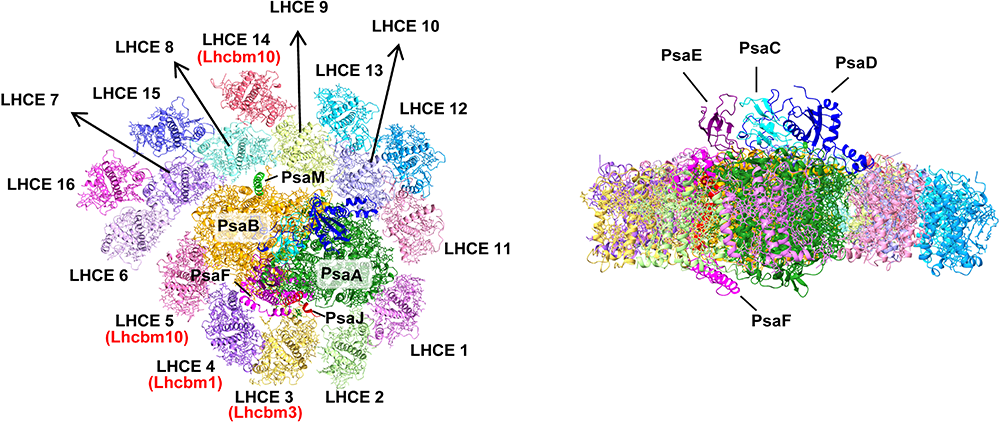
Fig. 1. Overall structure of the Euglena PSI-LHCE supercomplex
Contact:
Institute of Physics
WANG Yumei
Email:wangym@iphy.ac.cn
Key words:
Euglena gracilis; Cryo-EM; Photosystem I;
Abstract:
A research team led by Associate Professor Yumei Wang from the Institute of Physics, Chinese Academy of Sciences has used cryo-electron microscopy to determine the 2.23 Å high-resolution structure of the Euglena gracilis photosystem I–light-harvesting complex (PSI-LHCE) supercomplex. The structure shows that this complex has an unusually diverse set of antenna subunits, assembled from 12 distinct Lhca proteins and four different Lhcbm proteins, rather than repeats of the same protein type. Researchers also found that all antenna proteins bind the red-lineage carotenoid diadinoxanthin, and multiple diadinoxanthin molecules were identified within the core where green algae typically use β-carotene, revealing a "red-green mosaic" pigment integration strategy. In addition, the study uncovered that PSI-LHCE has a "small core, large antenna" organization, and that tight interactions among antenna subunits are key to forming and stabilizing the supercomplex. This work provides important new molecular details on how secondary endosymbiotic algae have evolved specialized photosynthetic structures for efficient light capture and energy transfer, and was published in Science Advances.