


Researchers Realize Room-temperature Two-dimensional Multiferroic Metal
Date:06-03-2026 Print
Multiferroic materials, which integrate ferroelectric and magnetic orders through magnetoelectric (ME) coupling, enable electric-field control of magnetism. However, bulk multiferroics face limitations, including relatively small spontaneous polarization, weak ME coupling coefficients, and limited operational stability under ambient conditions due to oxygen-vacancy-induced leakage currents, which restrict their practical applications.
The emergence of two-dimensional (2D) materials provide a new way to overcome these challenges through atomic-scale structural and electronic engineering, but realizing room-temperature (RT) 2D multiferroics with robust intrinsic ME coupling remains elusive. The development of air-stable 2D multiferroics exhibiting strong ME coupling at RT calls for new material design concepts.
In a study published in Nature Materials, researchers from the Institute of Physics of the Chinese Academy of Sciences, along with the collaborators from Zhejiang University, discovered intrinsic RT multiferroicity with strong magnetoelectric coupling in 2D van der Waals material, and realized electric-field control of magnetic states in it.
Researchers identified a novel alternating antiferromagnetic (AFM)/ferromagnetic (FM) layered configuration in bilayer CrTe₂, in which the interlayer electrostatic potential difference intrinsically broke inversion symmetry and gave rise to reversible out-of-plane polarization. They then realized high-quality bilayer CrTe₂ films via molecular beam epitaxy, demonstrating a RT-stable 2D multiferroic phase.
First-principles calculations combined with scanning tunneling microscopy, piezoresponse force microscopy and magnetic force microscopy confirmed that the electrostatic potential difference between the AFM and FM layers induced spontaneous inversion symmetry breaking and generated robust ferroelectric polarization. Different from spin-orbit-coupling-driven mechanisms in typical type-II multiferroics, this interlayer charge-asymmetry mechanism enabled strong magnetoelectric coupling that persisted up to RT.
The proposed FM/AFM superlattice structure establishes a universal design principle for engineering 2D single-phase multiferroics. The RT and air-stable "electrical writing and magnetic reading" demonstrated in bilayer CrTe₂ bridges the gap between fundamental multiferroic physics and scalable applications, which positions 2D multiferroics as a viable platform for CMOS-compatible, energy-efficient spintronic memory, accelerating their integration into post-Moore nanoelectronics.
The study was supported by the National Science Foundation, the Ministry of Science and Technology of China, the Chinese Academy of Sciences, Beijing Natural Science Foundation, the Anhui Initiative in Quantum Information Technologies, National Program for Support of Top-notch Young Professional, and the Super Computer Centre of USTCSCC and SCCAS.
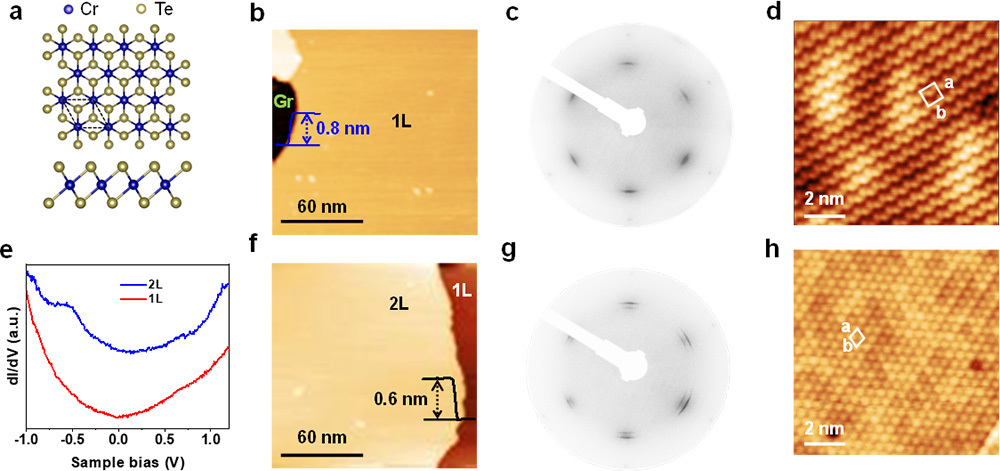
Fig. 1 Atomic-scale structural and electronic characterization of ML and BL CrTe₂.
(Image by Institute of Physics)
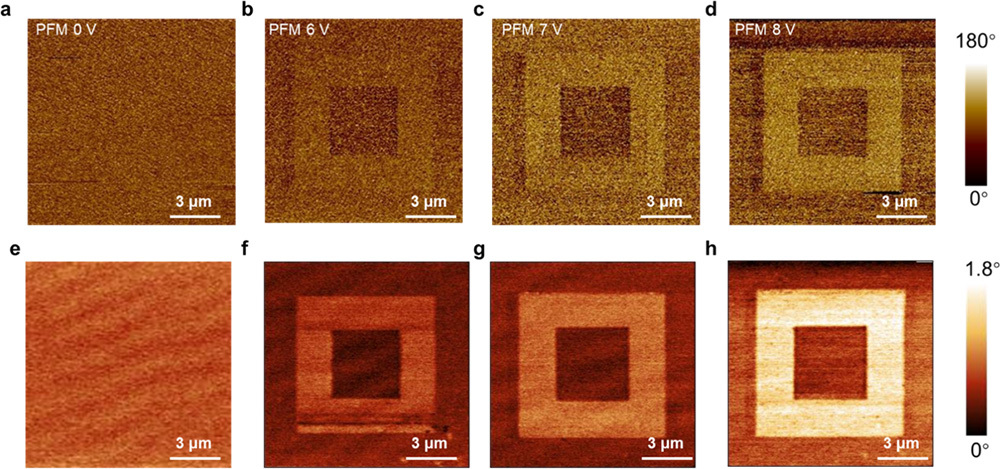
Fig. 2 Electrical writing by PFM and magnetic reading by MFM for multiferroic BL CrTe₂.
(Image by Institute of Physics)
Contact:
Institute of Physics
CHEN Lan
Email:lchen@iphy.ac.cn
Key word:
two-dimensional multiferroics; magnetoelectric coupling; molecular beam epitaxy; scanning probe microscopy.
Abstract:
Air-stable bilayer CrTe₂ exhibits intrinsic room-temperature multiferroicity. Structural and magnetic characterization reveal an alternating ferromagnetic and antiferromagnetic bilayer architecture, in which interlayer charge transfer spontaneously breaks inversion symmetry and generates a robust, switchable out-of-plane ferroelectric polarization. Scanning probe microscopy further confirms non-volatile electric-field control of the magnetic configuration, enabling electrical writing and magnetic reading functionalities.