


Field-Symmetry-Engineered Magnetotransport in Magnetic NiO/Co/ Pt Heterostructures
Date:12-03-2026 Print
Symmetry, as a fundamental law governing the structure and function of physical systems, lies at the forefront of developing novel functional devices. For a long time, the control of physical responses like magnetoresistance has primarily relied on static material design, with device functionalities fixed after device fabrication, limiting reconfigurability. This has constrained in-depth exploration of complex spin configurations and the development of programmable devices in spintronics. More fundamentally, this 'static design' paradigm stems from the traditional view of 'symmetry' as an inherent, descriptive static property of materials, rather than a dynamically programmable physical dimension. Therefore, the key scientific challenge lies in transforming symmetry from a passive attribute into an active control parameter, enabling reversible switching between different symmetry configurations (e.g., odd, even) on demand within a single ferromagnetic system. This shift is crucial for breaking the existing paradigm and realizing functionally reconfigurable devices. It presents a challenge not only to spintronics but also a universal question regarding 'function-on-demand programming' across a broader range of physical systems.
Recently, Associate Professor Feng Jiafeng and Professor Han Xiufeng from the M02 Group at the National Key Laboratory of Magnetism, Institute of Physics, Chinese Academy of Sciences, in collaboration with Professor Wang Yi from Dalian University of Technology and Professor Liu Yaowen from Tongji University, have experimentally achieved, for the first time, bidirectional and reversible electrical switching among three distinct magnetoresistance symmetry configurations at room temperature in NiO/Co/Pt magnetic heterostructures. This was accomplished using magnetic field symmetry programming. The configurations are: asymmetric magnetoresistance (AS-MR), forward-symmetric magnetoresistance (FS-MR), and reverse-symmetric Magnetoresistance (RS-MR) (Fig. 1a). The NiO/Co/Pt heterostructure itself exhibits typical odd-symmetry AS-MR behavior due to the anomalous Hall effect (Fig. 1b), with its resistance peaks satisfying Rxx(H) = -Rxx(–H). Through precisely designed preset magnetic fields, the research team successfully induced two even-symmetry magnetoresistance states (FS-MR and RS-MR, Fig. 1c, d). Specifically, FS-MR follows +Rxx(H) = +Rxx(–H), showing upward resistance peaks in both positive and negative field directions, corresponding to a dual-high-resistance state. In contrast, RS-MR follows -Rxx(H) = -Rxx(–H), presenting downward resistance peaks, forming a dual-low-resistance state. The physical mechanism of switching is revealed to involve the selective inversion of the asymmetric resistance peaks under specific field symmetry control: the resistance peak shape in one field direction undergoes an 'up-down' mirror flip, while the peak shape in the opposite direction remains unchanged (Fig. 1a).
The key innovation of this work lies in establishing the symmetry of the magnetic field itself as an independent, programmable core order parameter through the preset field. This enables the dynamic 'writing' and 'erasing' of the topological configuration of the magnetoresistance response function. This work fundamentally breaks the traditional paradigm of relying on static material design to fix magnetoresistance functionality, demonstrating for the first time in a single ferromagnetic material a novel pathway to directly 'tailor' the system's electrical response through a preset external field. This not only provides a prototype for developing programmable spintronic device resistance states but also signifies a paradigm shift in magnetoresistance research and functional materials—from 'static property engineering' towards 'dynamic symmetry control and programming'. The related results are published in Nano Letters under the title "Field-Symmetry-Engineered Magnetotransport in Magnetic NiO/Co/Pt Heterostructures" (https://doi.org/10.1021/acs.nanolett.6c00125). Associate Professor Feng Jiafeng from the Institute of Physics, Chinese Academy of Sciences, is the first author and corresponding author. Associate Researcher Yan Liqin from the Institute of Physics, Chinese Academy of Sciences, Professor Liu Yaowen from Tongji University, and Professor Wang Yi from Dalian University of Technology are co-corresponding authors. This research was supported by the National Key R&D Program of China and the National Natural Science Foundation of China.
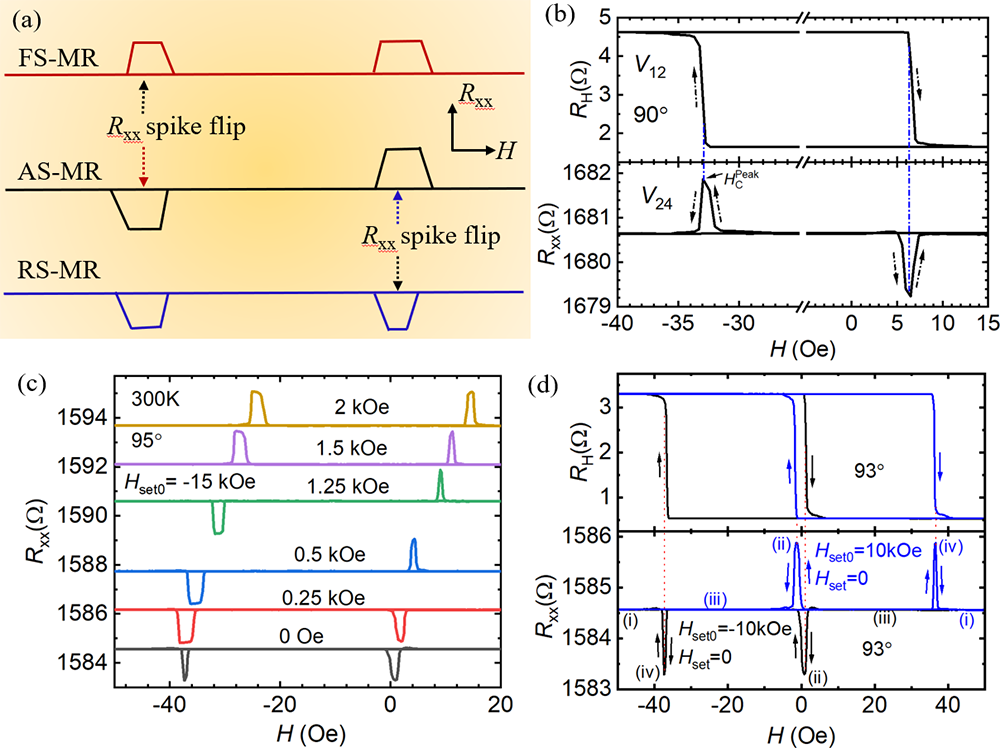
Figure 1:Schematic diagram of the magnetoresistance effect regulated by magnetic field symmetry and experimental observation results. (a) Schematic diagram of the principle of magnetoresistance effect regulated by magnetic field symmetry; (b) Asymmetric magnetoresistance (AS-MR) effect induced by the anomalous Hall effect; (c) Reversible switching among AS-MR, forward-symmetric magnetoresistance (FS-MR), and reverse-symmetric magnetoresistance (RS-MR) achieved via magnetic field symmetry by a tunable preset magnetic field; (d) Reversible switching between FS-MR and RS-MR.
Contact:
Institute of Physics
Feng Jiafeng
Email:jiafengfeng@iphy.ac.cn
Key words:
Field symmetry, Magnetoresistance symmetry, Reconfigurable spintronics, Nonreciprocal transport
Abstract:
Reconfigurable and reversible switching among asymmetric, forward-symmetric, and reverse-symmetric magnetoresistance configurations in NiO/Co/Pt heterostructures at room temperature by manipulating magnetic field symmetry. This active control of magnetoresistance symmetry via field-programming of the rotation sequence between interfacial and bulk Co moments provides a novel platform for programmable spintronic devices.