


Nanomagnets Turn Thermal Fluctuations into Calibration-Free Power-Law Computing
Date:23-11-2026 Print
Edge intelligence moves data processing from cloud data centers directly to local devices such as smart cameras, wearables, and industrial sensors. Unlike cloud servers, edge hardware operates under strict energy and chip-area budgets.
Many front-end sensing and artificial intelligence tasks—including root-mean-square normalization, image gamma correction, and audio dynamic range compression—rely on nonlinear rational power-law operations (xm/n) at 4- to 8-bit precision. Implementing adjustable power laws with conventional digital circuits requires large lookup tables or power-hungry multiply-accumulate units.
Stochastic computing offers a compact alternative by encoding numbers as probabilities in random bitstreams. However, nanoscale hardware random sources suffer from device-to-device manufacturing variations and temperature drift, which previously forced engineers to calibrate each device individually offline.
In a study published in Applied Physics Reviews (selected as a Featured Article), researchers from the Institute of Physics (IOP) of the Chinese Academy of Sciences and their collaborators developed a calibration-free stochastic power-law computing method using spin-orbit torque magnetic tunnel junctions (SOT-MTJs).
The team used a three-terminal tungsten-based SOT-MTJ with an elliptical pillar measuring 300×100 nm2 and a room-temperature tunneling magnetoresistance ratio of 175%. Driven by 50 ns write pulses, the nanomagnet's intrinsic thermal fluctuations generate true random Bernoulli bitstreams without requiring an external magnetic field.
To eliminate offline calibration, the researchers introduced an event-driven stochastic integral feedback loop. For a given input b∈(0,1) and exponent denominator n, the controller samples the device n consecutive times and checks whether all n bits equal "1". It lowers the write voltage by l(1-b) when an all-ones event occurs and raises it by lb otherwise.
At steady state, this feedback automatically locks the device's single-shot switching probability to b1/n without prior knowledge of device parameters. Grouping the output bitstream into blocks of length m and counting all-ones blocks yields bm/n, allowing multiple counters in parallel to decode several power exponents from a single bitstream simultaneously.
Across 25 tested SOT-MTJs, the 50% switching voltage averaged 1.881±0.151 V with a transition-slope variation of 24.96%. Starting from 0 V with a 50 mV step size, the system converged within about 200 samples. Measured values for 0.53/2, 0.51/3, and 0.53 deviated from theoretical values by 0.003, 0.001, and 0.002, respectively, while five outputs (0.51/3 to 0.55/3) were decoded in parallel from one bitstream.
In a 4-bit image gamma correction (y = x5/11) demonstration, the hardware preserved dark-region textures that were lost under linear quantization, reaching a peak signal-to-noise ratio (PSNR) of about 35 dB at 1,000 samples. When exposed to an abrupt 5 Oe external magnetic field disturbance, the loop re-locked within tens of update cycles. Across joint variations of ±90% in both threshold voltage and slope, all 25 devices maintained an average PSNR of 34.83 dB .
"By combining device physics with closed-loop feedback, this approach turns inherent nanoscale device variations into a self-regulating computing resource," said Prof. HAN Xiufeng from IOP. "It removes the offline calibration overhead for probabilistic hardware in low-power edge computing."
Researchers from Far Eastern Federal University and Nanjing University of Posts and Telecommunications also contributed to this work, which was supported by the National Key Research and Development Program of China, the National Natural Science Foundation of China, the CAS President's International Fellowship Initiative, and the Russian Science Foundation.
Paper link: https://doi.org/10.1063/5.0352180
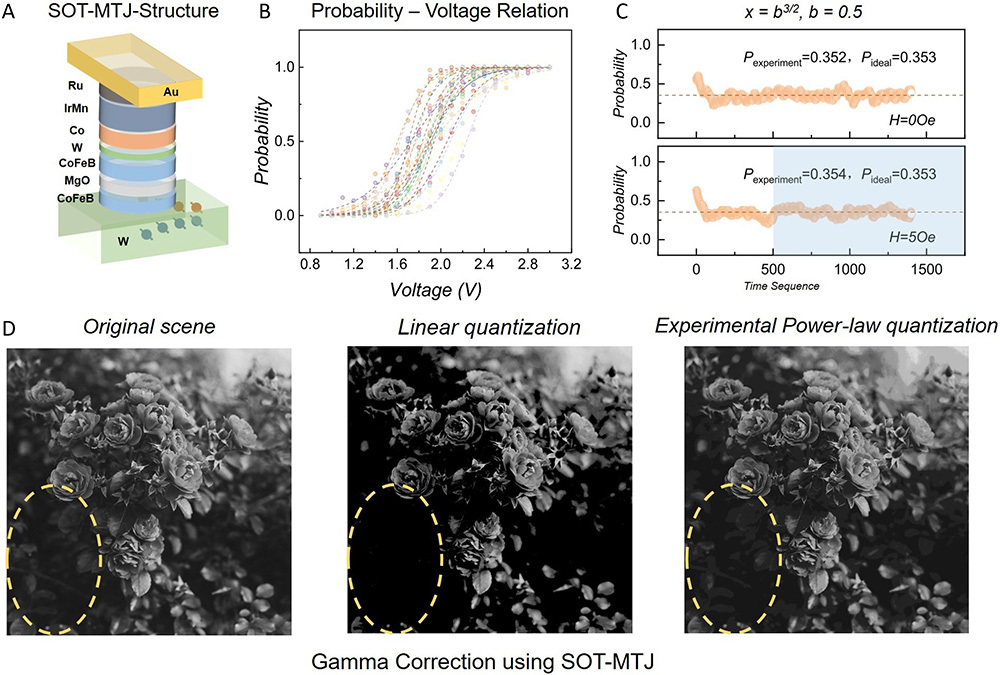
Fig. Principle and experimental demonstration of calibration-free stochastic power-law computing using SOT-MTJs. (A) Three-terminal SOT-MTJ structure; (B) switching probability–voltage curves of 25 devices; (C) online convergence and recovery under a 5 Oe magnetic field disturbance; (D) comparison of original, linearly quantized, and SOT-MTJ gamma-corrected images. (Image by Institute of Physics)
Contact:
WAN Caihua
Institute of Physics
wancaihua@iphy.ac.cn
Key words:
Spintronics; Stochastic computing; Magnetic tunnel junction; Edge intelligence;
Abstract:
Nanoscale stochastic computing devices often require individual offline calibration due to manufacturing variations and environmental drift. Researchers at the Institute of Physics demonstrated an event-driven feedback method for spin-orbit torque magnetic tunnel junctions that automatically locks switching probabilities to execute rational power-law operations without calibration.