


Magnetic control of pair creation in spatially localized supercritical fields
Date:09-01-2013 Print
Theoretical investigation of laser-triggered pair creation has become a hot research topic and many works have examined how one could use external electric fields to control the pair creation process. However, up to this point knowledge about the effect caused by a localized magnetic field has been very limited.
Recently, researchers from the group of High Field Physics in the Institute of Physics of CAS, together with collaborators from China University of Mining and Technology, Shanghai Jiao Tong University, MPIK (Germany) and Illinois State University (US) studied the impact of a static magnetic field on the creation mechanism of electron-positron pairs in a supercritical static electric field when the fields are perpendicular to each other. While both fields are localized along the direction of the electric field, if the spatial extent of the magnetic field exceeds that of the electric field, quantum field theoretical simulations based on the Dirac equation predict a suppression of pair creation even if the electric field is supercritical.
Furthermore, an arbitrarily small magnetic field outside the interaction zone can even bring the creation process to complete halt, if it is sufficiently extended [see Fig. 1]. The mechanism for this magnetically-induced complete shutoff can be associated with a re-opening of the mass gap and the emergence of electrically-dressed Landau levels [see Fig. 2].
For more details, see: Phys. Rev. Lett. 109, 253202 (2012).
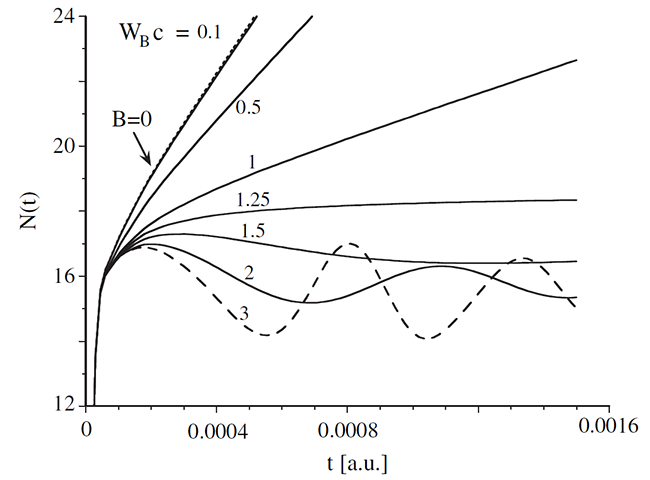 |
| Fig.1 The final number of created electron-positron pairs as a function of the interaction time for eight different widths of the magnetic field. B=0 case is the upper dashed line.(Image by LU Xin et al) |
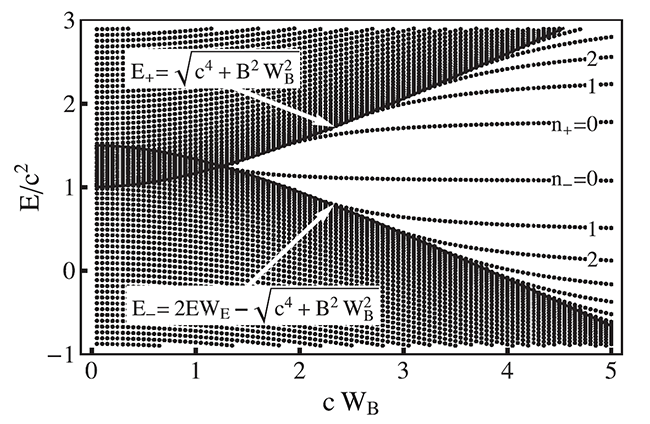 |
| Fig.2 The energy spectrum of the total Hamiltonian as a function of the spatial size of the magnetic field WB. All parameters are the same as in Fig. 1. It is apparent that when WB > 1.25/c the two continua begin to separate from each other. In the band gap area new discrete energy levels emerge. (Image by LU Xin et al) |