


Researchers Make Progress in Investigation of Nematic Spin Correlations in the Tetragonal State of Uniaxial-strained BaFe2-xNixAs2
Date:25-09-2014 Print
Understanding the electronic anisotropic state at a temperature associated with the nematic phase is one of the most important unresolved problems in the quest for mechanism of high-Tc superconductivity in iron pnictides. Upon warming to above the antiferromagneitc (AF) order (TN) and orthorhombic lattice distortion (Ts) temperatures, the iron pnictides become paramagnetic tetragonal metals, but still have anisotropic features in transport results within FeAs plane. Such electronic anisotropy is explained as orbital ordering or local impurity scattering. Since it breaks the 4-fold rotating (C4) symmetry, it is also taken as a strong evidence for electronic nematicity at high temperature. If indeed this case, one also would be expected spin nematicity in the tetragonal phase of iron pnictides.
Recently, Prof. DAI Pengcheng’s team from Beijing National Laboratory for Condensed Matter Physics at the Institute of Physics, Chinese Academy of Sciences focused on the electron doped iron arsenide BaFe2−xNixAs2 and carried out polarized neutron scattering on the twinned single crystals. One key result is the low-energy spin excitations in these materials is highly anisotropic within FeAs plane, and the spin anisotropy persists into the tetragonal phase well above Ts and TN corresponding to the onset of the in-plane resistivity anisotropy (H. Luo et al., Phys. Rev. Lett. 111, 107006 (2013)).
To further explore whether a spin nematicity exist in BaFe2−xNixAs2 system, LU Xingye, ZHANG Rui and LUO Huiqian in Prof. DAI Pengcheng’s group, in collaboration with J. T. Park from Heinz Maier-Leibnitz Zentrum Germany have done inelastic neutron scattering studies on detwinned BaFe2−xNixAs2 single crystals, with theoretical help from Prof. NEVIDOMSKYY Andriy and Prof. SI Qimiao from Rice University. In the parent compound BaFe2As2 and underdoped sample BaFe1.915Ni0.085As2, they have found that the spin excitations develop an anisotropy in spectral weight between the Q= (±1, 0) and (0,±1) positions at a higher temperature T* > Ts. It is also around this temperature that the resistivity measurements in detwinned crystals reveal anisotropy. While in the overdoped BaFe1.88Ni0.12As2 without resistivity anisotropy, the spin excitations are isotropic at all measured energies. This is the first time to observe electronic nematicity in spin channel of iron-based superconductors. Their results represent the unveiling of the nematic spin correlations, establish that they are intrinsic, and show that they persist in the quantum fluctuation regime close to the optimally electron-doped iron pnictide superconductor.
This work was published on the Science [X. Lu et. al., Science 345, 657(2014)]. It was supported by the National Basic Research Program of China (Grant No. 2012CB821400 and 2011CBA00110) and the National Science Foundation of China, together with other grants from USA.
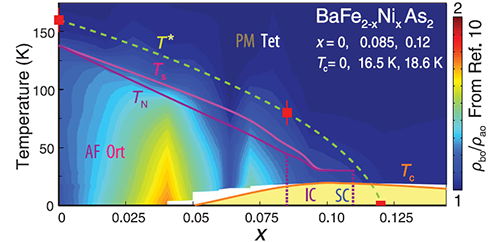 |
| Fig.1 The electronic phase diagram of BaFe2−xNixAs2from resistivity anisotropy obtained under uniaxial pressure. The spin excitation anisotropy temperatures are marked asT*. The AF orthorhombic (Ort), incommensurate AF (IC) , paramagnetic tetragonal (PM Tet), and superconductivity (SC) phases are marked. |
CONTACT:
Prof. DAI Pengcheng
Institute of Physics, Chinese Academy of Sciences
Email: pcdai@iphy.ac.cn